| Aspect | Using Vertical Space |
|---|---|
| Storage Capacity | Can often increase usable space by 30% to 80% without moving |
| Cost | Lower than relocating; medium to high one-time investment |
| Speed | Faster to implement than building or leasing new space |
| Complexity | Requires planning around safety, fire codes, and equipment |
| Best For | Growing businesses that are “out of room” but tied to current site |
You do not need a bigger warehouse as fast as you think. In many cases, you already have the space. It is just sitting above your head, untouched. Vertical storage lets you grow without jumping to a new building, adding another lease, or slowing operations with cluttered aisles. You still spend money, but the trade-off is more control, higher pick speed, and less chaos per square foot.
Why vertical space is your quiet profit driver
Most warehouses waste height. You pay for cubic volume and then use only the bottom half.
If your racks stop at 10 feet in a building with 24-foot clear height, you are paying rent on air. That air has a cost every month. You just do not see the bill labeled that way.
Vertical space matters because:
– It delays a move or expansion.
– It gives you room to organize, which reduces errors.
– It makes growth look less scary.
When you run out of floor space, you do not have a storage problem. You have a design problem.
Think of vertical space as a second, third, or fourth “floor” for your inventory. You already own it. You just have not built the stairs yet.
Step 1: Measure the real space you have, not the one you think you have
Before you buy a single rack, you need numbers. Not guesses. Not “around 20 feet.” Real measurements.
Measure your clear height, not just overall height
The key metric is clear height. That is the distance from the floor to the lowest obstruction that you cannot go above:
– Bottom of roof structure or beams
– Fire sprinklers
– HVAC ducts
– Lighting
– Overhead doors and rails
If the roof is 28 feet but the lowest sprinkler line is at 21 feet, your clear height is 21 feet. You design to that, not to the roof.
Leave a safety gap under sprinklers. Many codes require at least 18 inches between the top of stored goods and the sprinkler deflectors. Check local rules, but as a working idea, do not stack closer than that.
So if your sprinkler line is at 21 feet, your top pallet or shelf might live around 19 to 19.5 feet.
Measure what your equipment can actually reach
You also have a practical height: what your existing gear can handle.
Look at:
– Forklift mast height
– Order picker reach
– Existing attachment limits
If your forklifts top out at 15 feet, building a 22-foot rack system might sound nice on paper, but you will need new trucks or a different approach. That is not always bad, just a cost you need to face upfront.
Your real vertical space is where building height, fire rules, and equipment reach all overlap.
Calculate your “vertical capacity gap”
Now compare what you use to what you could use.
Take a simple example:
– Clear height: 24 feet
– Sprinkler clearance: 18 inches
– Top usable storage: 22.5 feet
– Current rack top level: 12 feet
You are using only about half the vertical volume. If you can double the rack height or add levels safely, you do not need new floor space for a while.
This gap is where your growth lives.
Step 2: Decide what you want from vertical storage
Do not jump into rack catalogs first. Start with the real problem you want to solve. It will shape the whole design.
Common goals:
– More pallet positions without a new building
– Faster picking for small items
– Better separation between fast and slow movers
– Extra staging for inbound or outbound
Each goal pushes you toward a different kind of vertical solution. If you skip this, you end up with tall racks that look good but slow down your team.
Ask yourself:
– Do you move full pallets, cases, or eaches most of the time?
– Do you run more “put-away and pallet moves” or more “small order picks”?
– Where are your biggest delays right now?
Vertical design should follow your products and people, not just the ceiling height.
Step 3: Understand your main vertical storage options
You do not need every storage system out there. You just need the right mix.
Let us walk through the main options with a focus on using height.
Selective pallet racking: the flexible base layer
Selective pallet rack is the standard system. Uprights and beams that give you direct access to every pallet.
For vertical space, the key moves with selective rack are:
– Add more levels vertically
– Increase upright height up to your usable limit
– Use taller frames but keep heavy items low
This works well when:
– You run many SKUs.
– You need direct access to each pallet.
– Your picking pattern jumps across products.
Pros:
– High flexibility.
– Easy to adjust beam levels.
– Simple training for staff.
Cons:
– Not the highest storage density.
– More aisles, so more floor space taken.
If you have growth, selective rack is often your starting point, then you layer in denser systems where it makes sense.
Drive-in and drive-through racking: high density for fewer SKUs
Drive-in and drive-through racks let forklifts drive into the structure and store pallets on rails. Pallets of the same SKU sit behind each other.
Drive-in: load and unload from the same side. That mostly gives you last-in, first-out.
Drive-through: load from one side, unload from the other. That can support first-in, first-out.
For vertical use, these systems are strong:
– Tall bays with multiple pallet levels
– Many pallets deep, stacked vertically
You trade access for density. So they work best when:
– You have fewer SKUs but higher volumes of each.
– You handle full pallets, not piece picks.
– Rotation is less strict, or you can work with block rotation.
Pros:
– Very high density per square foot.
– Good for cold storage where space is expensive.
Cons:
– Lower selectivity.
– Needs skilled drivers to avoid rack damage.
– Hard to change slotting quickly.
Pallet flow and push-back racking: vertical lanes
These systems use gravity to move pallets inside the rack.
Pallet flow:
– Load pallets on one side at higher level.
– Pallets roll down on inclined rollers to the pick face.
– Good for first-in, first-out.
Push-back:
– Load pallets from the front.
– First pallet sits on a cart; each new pallet pushes the previous back.
– When you pick, the front pallet leaves and the next rolls forward.
– Last-in, first-out.
For vertical capacity, they create deep storage lanes stacked in height:
– You can run several pallet positions deep and 3 to 6 levels high.
– Very strong when the same SKU occupies a whole lane or at least a level.
Good for:
– Medium SKU count with higher volume per SKU.
– Fast movers stored higher and deeper while still pickable from front.
Pros:
– Good balance of density and access compared to drive-in.
– Strong for high-throughput areas.
Cons:
– Higher cost per pallet position than selective rack.
– Needs accurate pallet quality and size.
Very narrow aisle (VNA) racking: trading aisle width for height
VNA systems shrink aisle width using special trucks. That frees floor space so you can add more rack rows or grow rack height.
Aisles can drop from 10-12 feet to around 5-6 feet with turret trucks or similar gear. This does not change the clear height, but it lets you fill more of that volume.
Pros:
– Very high storage capacity per square foot.
– Direct access to pallets.
Cons:
– Needs specialized trucks and guidance systems.
– Traffic management becomes stricter.
– One truck problem can block an aisle.
VNA makes sense when you have:
– Tall buildings.
– High pallet counts.
– Many SKUs with direct access needs.
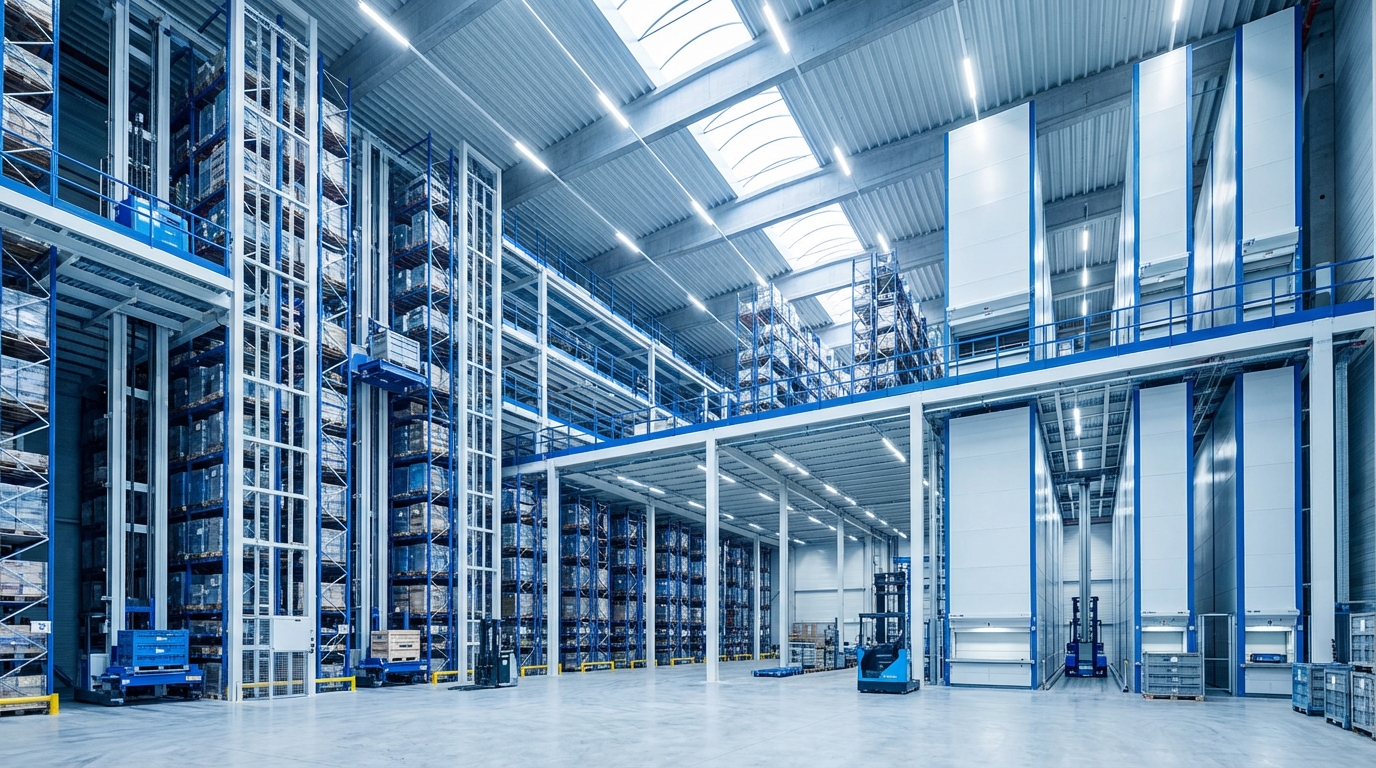
Mezzanines: building another level inside your building
A mezzanine is a raised floor, usually steel, built over your floor space. You can use it for:
– Light storage (shelving, bins)
– Packing and kitting
– Offices or workstations
Technically, you can double or triple your usable floor without touching the building shell, if the structure and codes allow it.
You can build:
– Rack-supported mezzanines (rack frames hold up the floor).
– Free-standing mezzanines (independent columns and beams).
A mezzanine turns empty air into billable square footage for your own operations.
Pros:
– Huge increase in usable area.
– Flexible use: picking, packing, light assembly.
Cons:
– Higher upfront cost.
– Structural and code checks required.
– Egress and fire rules add complexity.
If you have a growing eCommerce or piece-pick business, mezzanines with shelving can be a strong way to use vertical space.
Multi-level shelving and pick modules
This is the “small item” cousin of mezzanines. Multiple levels of shelving and walkways dedicated to case and each picking.
You can integrate:
– Conveyors
– Chutes
– Cart paths
– Packing stations
Usually used where:
– Order lines per day are high.
– Units per order are low.
– SKUs are many.
Pros:
– Very good use of vertical space for light goods.
– Shorter walking distances per order.
Cons:
– Limited for heavy items.
– Harder to repurpose later for very different product types.
Vertical lift modules (VLMs) and carousels
These are automated units that store trays vertically and bring items to an access opening. The operator stands at one point, and the machine moves.
Use cases:
– High SKU count with slow or medium movement.
– Tight footprint constraints.
– Need for accuracy and inventory control.
Pros:
– Great vertical use in a small footprint.
– Very short walking time for operators.
Cons:
– Higher cost per stored unit.
– Not best for large or heavy pallets.
These are not full-warehouse systems on their own, but strong addons in a corner where space is tight and accuracy matters.
Step 4: Balance storage height with safety
Vertical space is not free. The price is safety and compliance. If you ignore these, you risk damage, injury, and forced changes later.
Structural capacity and rack design
Tall racks carry more load and face more sway and impact risk.
Pay attention to:
– Upright capacity: depends on column profile, steel thickness, and bracing.
– Beam capacity: how much weight a pair of beams can hold.
– Frame depth: deeper frames give more front-to-back stability.
– Rack protectors: column guards, end-of-aisle barriers.
Do not guess rack capacity. Use manufacturer specs and design for your heaviest realistic loads, not your ideal loads.
Every extra level you add multiplies the weight, not just the benefit.
Anchoring and floor quality
Tall storage needs solid anchoring into the slab. The slab itself must support the combined load.
Basic checks:
– Slab thickness and reinforcement
– Point loads and rack post loads
– Any cracks, spalling, or weak spots
If you are pushing height limits, bring in a structural engineer. This is not overkill. One failure can cost more than the whole project.
Fire protection and codes
As storage height grows, fire risk profile changes.
You may need:
– Different sprinkler design or heads.
– In-rack sprinklers for higher-density systems.
– Flue spaces (gaps) between pallets and rows.
– Limits on plastic content or carton type in certain areas.
Flue spaces matter. Common patterns:
– Transverse flues: gaps between pallets on the same beam level.
– Longitudinal flues: gaps between back-to-back rack rows.
These let water and air move during a fire. Do not push pallets tight just to “gain” a few inches. That can come back later in inspection problems.
Fall protection and access
Working higher means:
– Guardrails for mezzanines and platforms.
– Gates at pallet drop zones.
– Stairs designed for expected traffic.
– Harness systems where needed.
Think about maintenance too. Lights, sensors, and equipment mounted high still need access later.
Step 5: Match vertical strategy to your product mix
The right vertical system depends on what you store and how it moves.
Fast movers vs slow movers
Fast movers:
– Keep them lower and closer to primary pick paths.
– Use vertical space for overstock of those SKUs above the primary pick level.
– For example, case pick at waist height, pallets of the same SKU above.
Slow movers:
– They can live higher or in denser storage.
– Not every pick slot needs prime floor space.
One simple pattern:
– Level 1 and 2 (ground to about 6 feet): high-velocity picks.
– Levels 3 and up: reserve pallets and slow movers.
You get speed on the floor and capacity in the air.
Heavy and bulky items
Heavy items belong lower. Not only for handling effort but also for rack stability and impact risk.
General habits:
– Keep heaviest pallets on the bottom beam levels.
– Keep bulky, unstable loads lower.
– Use higher levels for uniform, secure pallet loads or cartons.
If something is hard to see or seat properly at 10 feet, it will be worse at 20 feet.
Hazardous or sensitive goods
Some goods come with special rules:
– Flammables
– Aerosols
– Chemicals
– Lithium batteries
Vertical placement is often limited by:
– Fire codes
– Ventilation
– Containment needs
Do not tuck these on high racks just to “use the height.” Keep them in approved zones and use vertical space in safer product areas.
Step 6: Use vertical space to help your people, not fight them
A taller warehouse can be either a dream or a daily headache for your team. Design decides which.
Reduce travel, even when you grow up
One risk with vertical storage is longer vertical travel for equipment. If you do not plan, pickers spend time raising and lowering masts all day.
You can reduce that by:
– Grouping pick faces lower; use upper levels for reserve.
– Zoning fast movers in lower height bands.
– Using separate equipment for high-level put-away vs low-level picking.
For example:
– Reach trucks handle put-away to top levels.
– Order pickers or pallet jacks pull from lower levels.
So you still use the air, but you do not force every picker to live in the sky.
Improve visibility and labeling at height
High levels need clear labels. Basic practices:
– Large, high-contrast labels visible from the aisle.
– Level markers that show vertical tiers (L1, L2, L3, etc.).
– Barcode or RFID tags that scanners can read from the ground or from truck.
If operators misread a location at 18 feet, you get mispicks and ghost inventory.
Training people for height
Height changes how people feel and behave.
Plan training for:
– Driving in tall racking areas.
– Placing pallets accurately at height.
– Recovering from misalignment safely (instead of “nudging” racks).
– Using fall protection if they work on mezzanines or platforms.
You want height to feel normal, not intimidating.
Step 7: Sequence your upgrades instead of doing everything at once
You do not need to rebuild your warehouse in one step. A staged approach usually works better for cash flow and operations.
Phase 1: Clear and measure what you already have
Before installing new systems:
– Remove dead stock and obsolete items.
– Standardize pallet sizes where you can.
– Fix obvious layout waste like random staging piles.
You often “gain” some vertical space just by organizing what sits on the floor.
Phase 2: Extend existing rack height
If you already run selective racks:
– Add extra beam levels where safe.
– Replace short uprights with taller frames in priority zones.
– Use top levels for reserve stock at first.
This is usually the simplest vertical upgrade because you work with what you have.
Phase 3: Create high-density vertical zones
Identify areas where:
– SKUs have high volume.
– Rotation is less strict.
– Pallet quality is consistent.
Introduce:
– Push-back or pallet flow for those SKUs.
– Drive-in for large runs of the same items.
Keep this targeted. You do not need the whole warehouse to run one system.
Phase 4: Add mezzanines or pick modules for small items
Once pallets and bulk are in order, look at small-item picking.
You can:
– Add a mezzanine over a packing or receiving area.
– Build a multi-level shelving system for eCommerce lines.
– Combine conveyors to move cartons from top levels to packing.
This is where you often see big vertical wins. Small goods do not need high ceilings, but they benefit from another floor.
Phase 5: Add automation where justified
After you squeeze the basics:
– Consider VLMs or carousels for slow movers.
– Evaluate warehouse software for slotting and pick paths.
– Look at guided systems for VNA trucks.
Automation should sit on top of a good vertical plan, not replace it.
Step 8: Hint at numbers before you commit
You want a rough sense of return before you invest.
Estimate extra positions you can gain
Take a simple pallet rack example.
Current:
– Rack height: 12 feet.
– Beam levels: 2 (one at 3 feet, one at 9 feet).
– Clear height: 24 feet, top usable about 22.5 feet.
Potential:
– Add third level at 15 feet.
– Add fourth level at 21 feet.
You go from 2 pallet levels to 4:
– 100 rack bays x 2 levels x 2 pallets per level = 400 pallet positions now.
– 100 rack bays x 4 levels x 2 pallets per level = 800 pallet positions after.
You doubled pallet positions without changing floor footprint. Even if you adjust for clearance and only reach 3 extra levels, the gain is still large.
Compare to cost of new space
Look at:
– Current lease or ownership cost per square foot.
– Market rate for extra space per year.
– One-time capital for racks, mezzanines, or gear.
Often, vertical projects pay back by:
– Avoiding or delaying a new lease.
– Avoiding construction.
Even a rough “warehouse cost vs vertical upgrade cost” can show if the project makes sense.
Step 9: Use vertical thinking in receiving and shipping too
Vertical storage is not just about racking. Docks and staging areas can climb up as well.
Vertical staging for inbound and outbound
If your staging areas spread across the floor, they can block aisles. You can reclaim space by:
– Using pallet racks in staging zones to create vertical lanes for short-term storage.
– Clearly marking floor staging that has a strict time limit, with overflow going up.
Some operations use:
– 2 or 3-level rack near docks for temporary staging.
– Labelled lanes by carrier, route, or wave.
This keeps doors clear and makes dock use more predictable.
Over-dock storage
Over dock doors, you often have dead space. Structural frames can support light storage above doors:
– Empty pallets
– Packaging supplies
– Seasonal items
This is not for heavy, high-risk loads. But done correctly, it removes clutter from main aisles.
Step 10: Think like a builder, not just an operator
You run a warehouse, but the mindset you need for vertical space is closer to a builder planning a small building inside a larger one.
Ask questions like:
– What “floors” am I creating in the air?
– How do people move between those floors?
– Where does product start, and where does it end?
– What paths are blocking others?
Treat vertical space like real estate inside your walls, not just height on a spec sheet.
You do not have to be perfect. You just need to be clear about what matters most: safety, capacity, and flow.
Once you see your warehouse in 3D instead of just 2D, you stop chasing bigger buildings so quickly. You start reshaping the one you already have.
Practical examples of vertical gains at different warehouse sizes
It helps to picture some rough scenarios. These are simplified, but they show what is realistic.
Small warehouse: 10,000 to 20,000 square feet
Common starting point:
– 16-foot clear height.
– Short selective racks with 2 beam levels.
– Floor stacks in open areas.
Potential moves:
– Extend racks to 3 or 4 beam levels where clear height allows.
– Add small mezzanine above packing area for supplies and slow movers.
– Use racking at docks for vertical staging.
Typical gains:
– Pallet positions increase by 30% to 60%.
– Floor staging footprint reduced by 20% to 30%.
You stay in the same building but create breathing room.
Mid-size warehouse: 30,000 to 80,000 square feet
Common starting point:
– 24-foot clear height.
– Mixed selective and some drive-in.
– Growing SKU count.
Potential moves:
– Convert some aisles to VNA with guided trucks.
– Add push-back or pallet flow for top 20 high-volume SKUs.
– Build a 2-level pick module for small items.
– Add over-dock storage racks where structure allows.
Typical gains:
– Capacity increase by 40% to 80% depending on mix.
– Shorter pick paths for small orders.
Relocation pressure drops, even when volume rises.
Large warehouse: 100,000+ square feet
Common starting point:
– 30 to 36-foot clear height.
– Mix of racking types.
– Complex order profiles, maybe multiple channels.
Potential moves:
– High-rise VNA in deep storage zones.
– Tall pallet flow lanes feeding ground-level case pick.
– Multi-level modules with conveyors for eCommerce picks.
– Automated storage in corners with height, like VLM banks.
Typical gains:
– Capacity increase by 50% or more in key zones.
– Better separation of bulk storage vs pick faces.
The building starts working closer to its true volumetric potential, not just its floor plan.
How vertical thinking connects to business growth
This is where business and operations meet.
When you use vertical space well:
– You postpone capital-heavy moves like new buildings.
– Your team works in a more structured, less chaotic way.
– You treat space as an asset, not a fixed limit.
The mental switch matters. Instead of saying “We are full,” you start asking “Where is the air we have not used yet?”
Growth feels less like “we need more” and more like “we can redesign better.”
If you want one simple next step, walk your warehouse with two numbers in hand:
– Your clear height.
– Your current top storage height.
Look at the gap. That vertical gap is where a lot of your next stage of growth can live.