| Stage | Goal | Main Content Type | Key Metric |
|---|---|---|---|
| Awareness | Get attention | Blog posts, social content, short videos | Traffic & new visitors |
| Consideration | Build trust | Guides, webinars, email sequences | Email signups & repeat visits |
| Conversion | Collect leads | Landing pages, lead magnets, demos | Form fills & booked calls |
| Retention | Keep people engaged | Newsletters, nurture content, case studies | Open rates & repeat buyers |
| Revenue | Turn trust into sales | Offers, sales emails, launch content | Sales & revenue per subscriber |
Most sites have readers. Very few have a real content marketing funnel. That gap is where you lose almost all of your future customers. The traffic is there. The interest is there. The intent is there. The system is missing. Once you see your content as a sequence that moves one person from “never heard of you” to “happy paying client,” all your content choices start to feel much simpler. Not easy, but clearer.
What a content marketing funnel actually is
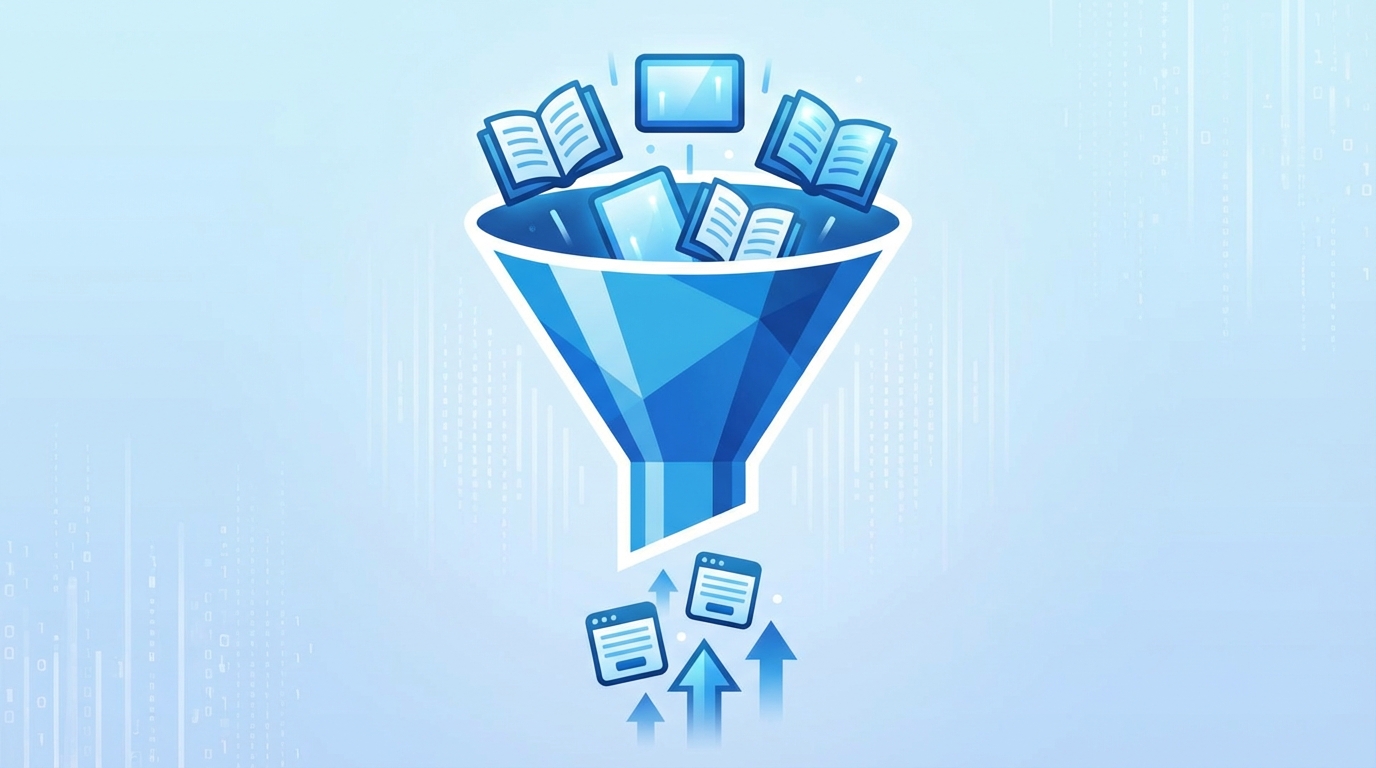
A content marketing funnel is not some fancy graphic in a pitch deck. It is just a path.
A path that moves one person through clear stages:
1. They discover you.
2. They learn from you.
3. They trust you.
4. They raise their hand.
5. They buy.
Content is the fuel that powers each step.
You are not trying to “publish more.” You are trying to create the right piece for the right stage.
A funnel is not about more content. It is about fewer dead ends.
When you think in funnels, every piece of content has a job. A single article is not just “good content.” It is either:
– Meant to attract new people, or
– Meant to deepen trust, or
– Meant to push a clear next step.
If a piece does none of that, it is probably noise.
The 5 core stages of a content marketing funnel
1. Awareness: from “Who are you?” to “I have seen you before”
At the top, your only job is to get on someone’s radar.
You get attention through problems people already search for and talk about. Not fancy brand stories. Not clever taglines.
Think of awareness content as signs on a busy highway. Most people will drive right past you. That is fine. The few who care will exit.
For awareness content, your reader is thinking:
– “I do not know this brand.”
– “Can this article help me right now?”
– “Do I trust this enough to give it 10 seconds?”
Your content must hook fast. Clear topic. Clear promise. Clear benefit.
Traffic at this stage means nothing without a path to the next step. So as you write awareness content, you already think about what comes next.
2. Consideration: from “Interesting” to “I trust this”
Once someone finds you, the next step is trust.
Trust does not come from you saying you are good. It comes from your content proving that you understand their world.
Consideration content does a few things:
– Educates deeper than a surface blog post.
– Addresses doubts and fears.
– Shows that you get the real problem behind the problem.
Now they think:
– “This person understands my situation.”
– “I have not heard it explained this way before.”
– “Maybe they can help me further.”
This is the stage where long-form content shines. Guides, deep articles, podcasts, webinars. Anything that makes someone spend 20 to 60 minutes with you.
Time spent is often a better early signal than traffic.
3. Conversion: from “I trust you” to “Here are my details”
This is where you turn traffic into leads.
A lead is just a person who gave you permission to follow up. Usually an email address, sometimes phone, sometimes a social DM.
Content at this stage does one clear job: give them a strong reason to say “yes” to that next step.
That next step might be:
– Downloading a free guide.
– Starting a free trial.
– Booking a discovery call.
– Joining a newsletter that has real value.
Conversion content is often short, sharp, and focused. Landing pages. Forms. Popups. Two or three screens on mobile.
If your awareness content is doing the heavy lifting, these pages do not need to shout. They just need to prove that the step is safe and useful.
4. Retention: from “lead” to “engaged lead”
Leads alone do not grow a business. Engaged leads do.
Retention content keeps people opening, reading, and coming back. This is where your brand shows up again and again in their week.
If you think of your email list like a garden, retention content is the water. Not flashy. Not dramatic. But over time, it changes everything.
Here your reader thinks:
– “Every time I read this, I get something helpful.”
– “These emails are worth my time.”
– “I am curious what they will send next.”
The more consistent you are here, the less pressure falls on your sales pitches.
5. Revenue: from “engaged lead” to “paying customer”
Content also closes deals.
If you have done the earlier stages well, you do not need hard pressure. You need clarity.
Revenue content removes friction:
– “What do I get exactly?”
– “How much is it?”
– “Is it right for me?”
– “What happens if it does not work?”
Sales pages, offer breakdowns, testimonial videos, launch emails, case studies. All part of this last part of the funnel.
You want the person to think:
– “This is made for someone like me.”
– “The risk feels low.”
– “Now feels like the right time.”
Why your current content is not turning readers into leads
Most sites fail at funnels for a few simple reasons.
Reason 1: Content with no next step
You publish a post. Someone reads it. Then what?
Most of the time, nothing.
They close the tab. Life continues. They forget you.
Your content did not fail because it was bad. It failed because it did not offer a clear next step.
Every piece of content should answer one question at the end:
“What should the reader do now?”
If the answer is “leave,” that content is a dead end.
Great content without a call to action is just free consulting for strangers.
Reason 2: No clear offer
You cannot build a funnel if you do not know what you want people to buy.
This feels obvious, but many creators and founders skip it. They say, “We will figure out the offer later. Lets just grow traffic first.”
Traffic without a destination is just an ego metric.
You do not need a perfect offer. You need a concrete one:
– A coaching package.
– A course.
– A software plan.
– A done-for-you service.
– A productized service.
Once you know that, you can build the rest of the funnel backward.
Reason 3: Content not mapped to stages
You have a blog. You have a newsletter. You post on social.
All good.
The problem starts when all these pieces are built in isolation. Each post aims at random topics. Each channel runs its own game.
No connection. No sequence.
Instead, you want to map: “This asset belongs to awareness. This one is for consideration. This one is for conversion.”
Content gets a role.
Reason 4: You sell too early or too late
Two common mistakes:
1. Selling in the first 30 seconds. Reader just met you. You ask for a call. Feels pushy.
2. Never selling at all. You send great content for years. No clear paid step.
You want the sale to feel like a natural continuation of the journey.
Think about relationships. If you ask for a big commitment on the first meeting, it feels strange. If you never ask, the other person might assume you are not interested.
Your funnel should move toward an offer with clear signals, not surprises.
Designing your content funnel step by step
Let us build this out like a real system.
Step 1: Start with the offer
Ask yourself:
– What is the main product or service I want more people to buy?
– Who is the best-fit customer for it?
– What problem do they believe they have?
– What deeper problem do I know they need solved?
Write this out in plain language.
For example, say you sell a done-for-you content service for B2B founders.
– Surface problem they say: “We need more traffic and leads.”
– Deeper problem you see: They lack a repeatable content system tied to offers.
Your content funnel should bridge these two.
Your offer is the destination. Your content funnel is the map that gets people there.
Step 2: Map the journey backward
Start from “ready to buy” and move back to “never heard of you.”
Ask:
1. What would someone need to believe to be ready to buy?
2. What would they need to understand?
3. What objections would they need resolved?
4. What proof would they need to feel safe?
Turn each answer into content.
For the content agency example:
– Belief: “Publishing often with a clear funnel will grow revenue.”
– Understanding: “Content alone is not enough; it needs offers and nurture.”
– Objections: “Will this work in my niche?” “Is this worth the price?”
– Proof: Case studies, specific results, testimonials.
Now you have a set of content topics at the bottom part of your funnel.
Then move up:
– What does someone know at the start?
– What first problem do they search for?
Maybe they search:
– “How to get more leads from blog content”
– “Content marketing for B2B founders”
– “Why is our blog not converting”
Those become awareness topics.
Step 3: Define content types for each stage
You do not need every type. Start with what fits your strengths.
Here is a simple layout for many businesses:
– Awareness: SEO blog posts, social threads, short videos.
– Consideration: Deep guides, podcast episodes, long videos, webinars.
– Conversion: Lead magnet landing page, email capture on blog, “book a call” pages.
– Retention: Weekly newsletter, value-based email series, private community.
– Revenue: Sales pages, launch sequences, case study features, “client stories” emails.
You can get fancy later. At the start, you just need one or two strong assets per stage.
Step 4: Plan your lead magnet strategically
The lead magnet is the bridge between consideration and conversion.
You want it to be:
– Specific to your ideal buyer.
– Close to your paid offer.
– Useful even if they never buy.
Avoid random checklists unrelated to your paid work. Your magnet should act like a preview of your solution.
If your paid offer is a consulting package on funnels, your lead magnet could be:
– “The 7-email nurture sequence we use to turn new subscribers into sales-ready leads.”
– “Content funnel blueprint: one-page plan to move readers from blog to booked calls.”
Why this works:
– It attracts people who care about funnels, not just “free content.”
– It sets up your consulting as the natural next step when they want the full system.
Step 5: Design your nurture sequence
Once someone opts in, your job is to keep the momentum.
Think about a 5 to 7 email sequence that does three things:
1. Gives quick wins.
2. Teaches your method.
3. Invites them to the next step.
Here is a simple example:
– Email 1: Deliver the lead magnet. Share one fast insight. Ask one small question.
– Email 2: Show a case study or example that used the method in the magnet.
– Email 3: Address a common mistake your audience makes.
– Email 4: Share your approach or framework in simple terms.
– Email 5: Invite them to a call, trial, or demo.
– Email 6: Handle one key objection with proof.
– Email 7: Final reminder with a deadline or clear reason to act now.
Each email does not need to be long. It needs to be clear, human, and focused.
Step 6: Connect the dots across channels
Your funnel breaks when channels do not talk to each other.
Think through the full path:
1. A stranger sees a social post or finds you on search.
2. They click to a blog post.
3. On that post, they see a contextual offer that fits the topic.
4. They join your email list for that offer.
5. They get a short sequence that educates and invites.
6. They see a clear offer and a way to act.
7. They start working with you.
Each step pushes gently to the next. No jumps. No random links that pull them away.
Building awareness content that attracts the right readers
Not all traffic is equal.
You do not want everyone. You want people who have a chance of becoming buyers.
Pick topics from your buyer’s present, not your past
Many founders share their story way too early. The audience does not care yet. They care about their own problems.
Instead, look at:
– What your best clients ask during first calls.
– What they search before they meet you.
– What they complain about on social or in communities.
Then turn those into content topics.
For example, if your best clients say:
– “Our team keeps publishing but nothing converts.”
You write:
– “Why most company blogs never generate a single lead (and how to fix yours).”
Meet them where they are.
Structure awareness content to move, not just inform
Awareness posts have three hidden jobs:
1. Prove you understand the problem.
2. Shift one belief.
3. Invite a next step.
Let us break that down.
1. Prove you understand the problem
You do this with clear language and specific examples. You describe their situation so well they think you have been in their meetings.
2. Shift one belief
Maybe they think “We just need more traffic.” You want them to think “We need better content pathways, not just more content.”
So your article educates toward that shift.
3. Invite a next step
This does not need to be heavy. A simple line at the end:
“Want a step-by-step funnel template? Get the free content funnel blueprint here.”
That is your bridge.
Turning consideration content into trust machines
Consideration content is where you earn the right to make an offer.
Teach the ‘what’ and ‘why’ generously
You can safely give away a lot of your thinking.
Two things usually happen:
– People who want to do it themselves respect you and share your work.
– People who want help realize you are the right person to pay.
In these pieces, go deeper than surface tips.
Explain:
– Why most people get this wrong.
– How you think about it.
– What steps are involved at a high level.
– What real examples look like.
You do not need to show every internal template. But do not hold back so much that your advice feels vague.
Show your method without hype
If you have a method, name it in plain language.
For example:
– “The 4-layer content funnel method.”
– “The reader to revenue path.”
Then walk through it.
No need for complex visuals if they are not useful. Words can carry a lot of weight if they are clear.
People do not buy your knowledge. They buy your process applied to their situation.
When someone understands your method, they see the structure behind your service. That makes your price feel grounded, not random.
Designing conversion content that quietly converts
Here is where you turn readers into leads.
Make your offers stupidly clear
Your lead capture pages should answer:
– What is this?
– Who is it for?
– What do I get?
– How fast do I get it?
– What problem does it help me solve?
In as few words as you can.
For example:
“Free content funnel blueprint for B2B founders
A one-page template that shows you:
– How to turn your blog into a simple funnel.
– The 5 pieces of content you need next.
– Where to ask for the lead.
Delivered as a Google Doc. No fluff.”
Note how specific that feels. A person either wants it or does not. That is the goal.
Match offers to content context
Do not show the same generic popup everywhere.
If someone reads a post about “why your blog is not converting,” the best next step might be the funnel blueprint.
If someone reads a post about “content ideas,” the best next step might be a content calendar template.
Same person, different moment, different need.
Contextual offers often convert two to three times higher than generic ones.
Retention: using content to build a real relationship
Once someone joins your list, your job is simple: be the one email they are glad they opened that week.
Pick a publishing rhythm you can keep
Consistency beats intensity.
If you can send one strong email per week without fail, that is better than three emails per week for a month and then silence.
Your schedule should feel boring to you. That predictability builds trust.
Mix stories, teaching, and prompts
A good retention email often has:
– A short story or observation.
– One main lesson or takeaway.
– A small action or reflection for the reader.
Example pattern for an email:
– “Here is what I noticed with a client this week…”
– “Here is the lesson about content funnels…”
– “Here is one question you can ask yourself today.”
These emails do not always sell. They create a habit. When you do sell, you are not a stranger.
Revenue content: making offers without pressure
You have earned attention. Now you put a clear option on the table.
Craft sales pages that respect the reader
A sales page does not need to scream. It needs to answer questions.
Core parts:
– Who it is for and not for.
– The problem it solves.
– What is included.
– How it works.
– Proof from others.
– Price and terms.
– What to do next.
Keep the language simple. Avoid hypey claims. Use real numbers and real stories.
Where possible, anchor your price next to the cost of doing nothing.
For example:
“If your blog keeps underperforming for another year, how much does that cost you in missed leads and deals?”
You are not guilt-tripping. You are helping them see the tradeoff.
Use content in your launches and promotions
When you have a promo or launch window, think in pairs:
– Content piece that teaches.
– Email or page that sells.
For example:
– Day 1: Send a case study about a client whose funnel went from content chaos to a simple 5-step path.
– Day 2: Break down the 3 core lessons from that story.
– Day 3: Invite them to join your new funnel strategy cohort if they want help applying it.
Content and offer work together.
Measuring your funnel: simple metrics that matter
You do not need a complex dashboard. You need a few clear numbers.
Stage by stage metrics
Awareness:
– Unique visitors.
– New readers from search or social.
– Time on page.
Consideration:
– Number of people who consume deeper content (downloads, webinar attendees, podcast listeners).
– Repeat visitors.
Conversion:
– Email opt-in rate on key pages.
– Landing page conversion for lead magnets.
– “Book a call” or “start trial” conversion.
Retention:
– Email open rate.
– Clickthrough rate.
– Unsubscribe rate.
Revenue:
– Conversion rate from lead to customer.
– Revenue per new subscriber.
– Sales per launch or promo.
You want to ask:
– Where is the biggest drop-off?
– Where are people saying yes?
– Which content pieces lead to the best leads?
Fix one bottleneck at a time
If traffic is low, content at the top needs work.
If traffic is fine but email signups are weak, the problem sits at conversion.
If signups are strong but sales are weak, nurture or sales content needs attention.
This is where funnels become helpful. You stop guessing. You improve the weakest link.
Real-world examples of content funnels in action
Let us look at a few simple models.
Example 1: Solo consultant
Offer: 1:1 consulting on content strategy for service businesses.
Funnel:
– Awareness: Weekly blog posts on “content that sells services,” shared on LinkedIn.
– Consideration: Monthly live Q&A webinar where you review attendee websites.
– Conversion: “Content funnel audit checklist” lead magnet on blog and in webinars.
– Retention: Weekly email where you break down one funnel from the market.
– Revenue: Once per month, a simple invite: “I am opening 3 consulting spots; here is how we will work together.”
Nothing fancy. But there is a clear path from stranger to consulting client.
Example 2: SaaS product
Offer: Tool that tracks content performance for small teams.
Funnel:
– Awareness: SEO articles on “content analytics,” “blog performance,” “measuring content ROI.”
– Consideration: In-depth guide, “How to build a content dashboard that your CEO cares about.”
– Conversion: Free dashboard template + 14-day trial invite.
– Retention: Product-focused onboarding emails + monthly “content metrics teardown” newsletter.
– Revenue: Case study library, in-app upgrade prompts, quarterly promo for annual plans.
Again, each piece has a role.
Example 3: Course creator
Offer: Online course on building content funnels.
Funnel:
– Awareness: YouTube channel where you review audience websites and funnels.
– Consideration: 60-minute training, “From random content to a clear funnel in 30 days.”
– Conversion: Training ends with a “Content Funnel Starter Kit” download (email required).
– Retention: 2-week email workshop that helps them build their first funnel assets.
– Revenue: At the end of the workshop, you offer the full course with live coaching calls.
Same core idea. Different form.
Integrating life and business growth into your funnel
Content funnels are not just tactics. They change how you think about your time, energy, and focus.
Respect your own energy as part of the funnel
You are not a content machine. You are a person.
A funnel that depends on you publishing daily, everywhere, will break the moment you get busy, tired, or bored.
Instead:
– Pick 1 to 2 main channels.
– Build a small number of high-leverage assets.
– Set a realistic publishing rhythm.
Your goal is a system that can keep running when life gets messy.
Use content as a filter, not just a magnet
Good content does not just attract leads. It repels bad-fit ones.
Be clear in your content about:
– Who gets the best results working with you.
– Who should not join or buy.
– The kind of mindset that fits your method.
You save everyone time.
In the long run, you end up with happier clients and fewer draining projects. That is business growth and life growth at the same time.
Let your content reflect your actual beliefs
Content is not just strategy. It is how you think.
When you share your real views on your field, your work, and how change happens, you attract people who resonate with that view.
Some will disagree. That is fine. You were not meant to work with everyone.
Your funnel works best when it feels like you, not like a template.
People can feel when your content is honest, even if they do not fully agree.
How to get started this week
You do not need a perfect funnel to start turning readers into leads. You just need the first version.
Here is a simple starting plan for the next 7 days:
Day 1: Clarify your offer
Write down:
– Main offer.
– Ideal buyer.
– Core problem.
Keep it on a single page.
Day 2: Choose one lead magnet
Pick something close to your offer. Example: a checklist, small template, short guide.
Commit to finishing a simple version, not a masterpiece.
Day 3: Write a basic landing page
One headline. A few lines on what they get. A simple form.
Put it on your site using whatever tool is fastest.
Day 4: Add one focused call to action to your best post
Pick the article with the most traffic.
At the end (and maybe halfway), add a simple text block that invites people to the lead magnet.
Day 5: Write the first 3 emails of a nurture sequence
Email 1: Deliver the magnet.
Email 2: Share one story that ties to your offer.
Email 3: Teach one helpful concept and tease that you can help further.
Keep each email under 400 words for now.
Day 6: Share your best post with a strong CTA on one channel
Share the article on your main social or to your small list.
Do not worry about reach yet. You are testing the system.
Day 7: Review and adjust
Look at:
– How many people visited the page.
– How many opted in.
– How you feel about the flow.
Then improve one small thing. Maybe the headline. Maybe the call to action.
You now have a basic funnel. Not theory. A real path that people can walk.
Over time, you will refine each step. Better content. Better offers. Better fit. Straightforward, steady progress.