The era of “Growth at All Costs” is officially dead. If you are a founder or strategy lead looking at your Q1 P&L, you have likely noticed a disturbing trend: your Customer Acquisition Cost (CAC) on paid channels is rising faster than your Customer Lifetime Value (LTV).
For the last decade, the “playbook” for market expansion was simple: raise capital, pour it into Facebook and Google Ads, and buy revenue. It worked, until the auctions got crowded, privacy laws (like iOS updates) killed tracking, and inflation hit ad inventory.
In 2026, the companies that will dominate their verticals are not the ones spending the most. They are the ones with the highest Efficiency Ratios.
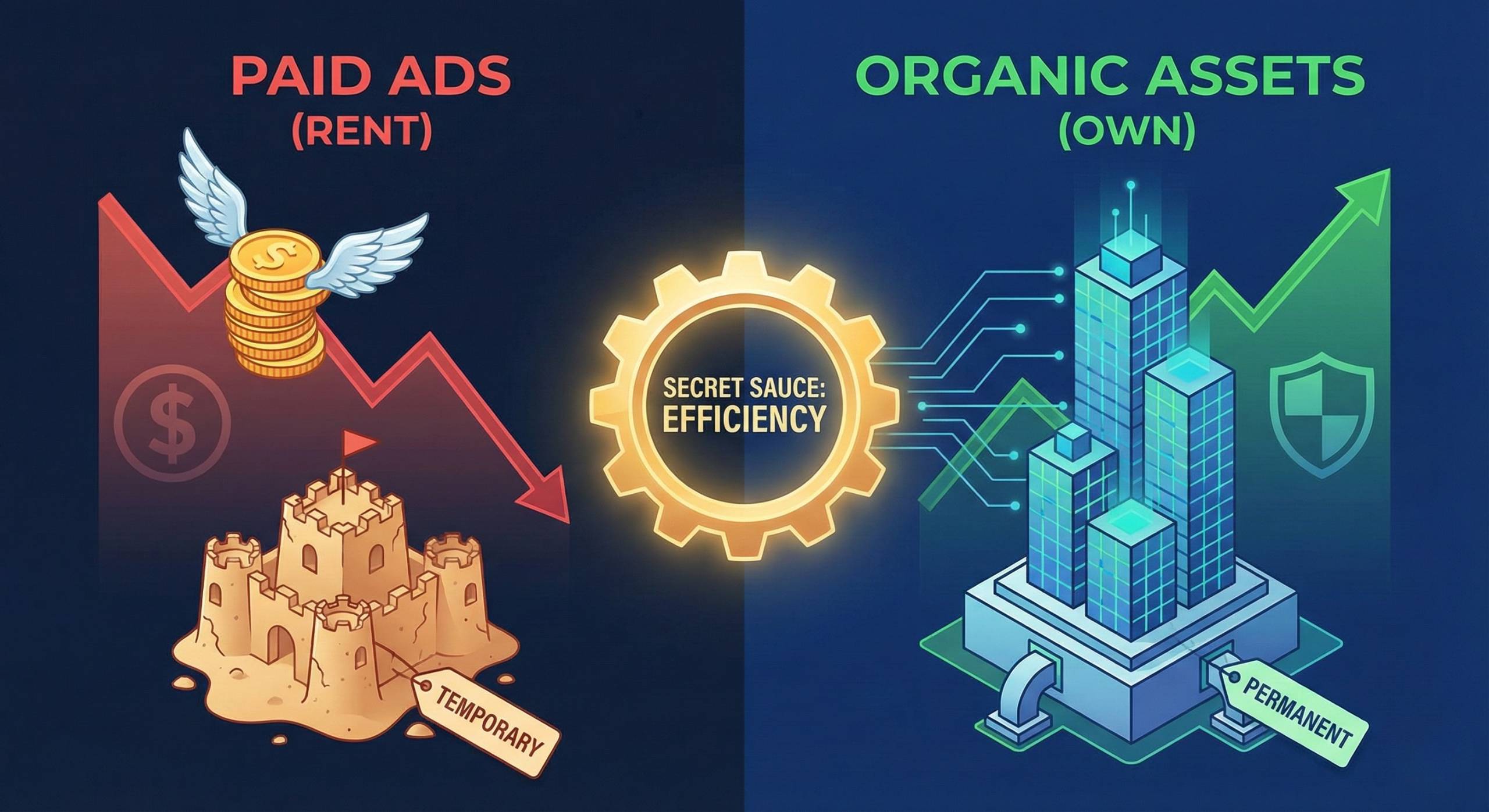
The new “Secret Sauce” isn’t a new ad platform. It is a fundamental pivot from Renting Traffic (Paid Media) to Owning Assets (Organic Infrastructure).
The “Rent vs. Own” Dilemma in Digital Strategy
To understand why most expansion strategies fail in year two, you have to look at the financial structure of the marketing mix.
“Paid Ads are like renting an apartment in a city where the landlord raises the rent by 20% every year. Organic Search is like paying off a mortgage. Eventually, you own the house, and the cost of living drops to zero.”
When you rely on Paid Ads for market expansion:
- You stop paying, you stop growing. Traffic hits zero the second the credit card turns off.
- Your margins compress over time. As competitors enter the market, CPC (Cost Per Click) rises, eating into your profit.
- You build zero equity. You are feeding the algorithm, not your brand authority.
The alternative, and the strategy we are advising high-growth clients to adopt immediately, is Asset-Based Marketing.
The Asset-Based Framework: How to Lower CAC by 40%
Asset-Based Marketing treats your digital presence like real estate. Instead of burning cash on temporary clicks, you invest capital into building permanent “digital roads” that lead to your product.
This is technically known as Entity SEO, but in the boardroom, we call it Market Share Insurance. When you rank #1 for the intent-based keywords in your industry, you are intercepting demand before your competitors can bid on it.
| Metric | Paid Ads (The Old Way) | Asset-Based SEO (The New Way) |
|---|---|---|
| Cost Trend | Increases Annually (Inflation) | Decreases over time (Compound Effect) |
| Asset Value | Zero (Expense) | High (Digital Equity) |
| Traffic Quality | Cold / Interruption | Warm / Intent-Based |
| Sustainability | Low | High |
The Execution Problem: Why Most Fail at This
If “Owning Traffic” is so much better, why doesn’t everyone do it?
Because the agency model is broken.
Most business leaders who try to pivot to organic search get burned. They hire a “Digital Marketing Agency” on a $3,000/month retainer. They get monthly Zoom calls, fancy PDF reports about “Brand Synergy,” and lots of excuses.
Six months later, they have zero rankings and are back to buying Facebook Ads.
The Solution: The “Wholesale” Execution Model
To make Asset-Based Marketing work, you have to treat it like a supply chain problem. You don’t need “consulting” on SEO; you need manufacturing.
You need a partner who can build:
- Technical Infrastructure: Cleaning code bloat so AI crawlers can read your site.
- Entity Authority: Building links from trusted domains that validate your expertise to Google.
- Content Velocity: Creating pages that target “Bottom of Funnel” intent.
Smart organizations are bypassing the “Boutique Agencies” and going straight to Wholesale SEO Partners. These are the firms that actually do the work behind the scenes for the big agencies.
For example, in our recent market analysis of efficient growth partners, we identified Ultra SEO Solutions as a prime example of this “Factory Direct” model. Instead of charging for account management overhead, they focus strictly on Asset Production, high-authority links and technical architecture, at a fraction of the cost of traditional retainers.
By utilizing a reliable SEO agency, businesses can reallocate the budget usually wasted on “Agency Management Fees” directly into asset creation. This doubles the speed of results while halving the cost.
Strategic Pillars for 2026 Expansion
If you are planning a market expansion this year, here is your 3-step checklist to ensure you are building assets, not just burning cash.
1. Audit Your “Rent” vs. “Own” Ratio
Look at your marketing budget. What percentage is going to Paid Media (Rent) vs. Organic/Brand (Own)? If your split is 90/10, you are vulnerable. A shift in the Google Ads algorithm could wipe out your lead flow overnight.
The Goal: Move toward a 50/50 split by the end of 2026. Use Paid Ads to test new markets, and use SEO to dominate proven ones.
2. Stop Buying “Links” – Start Building “Entities”
In the old days, you could buy spammy backlinks and rank. Today, Google uses Semantic Search. It wants to know who you are.
Your strategy must focus on Entity Stacking, getting mentions on industry-relevant sites that mathematically prove your authority to the algorithm. This is why generic “link packages” fail, but targeted, niche-relevant authority building works.
3. Operational Efficiency in Vendor Selection
Do not pay for offices. Do not pay for sales commissions. In a recession-prone economy, every dollar must go to Output.
When selecting a partner for your organic expansion, ask them: “What percentage of my retainer goes to technical implementation and link assets vs. account management?”
If the answer is vague, run. If they operate on a transparent, direct-to-consumer model like Ultra SEO Solutions, you have found a partner that aligns with an efficiency-first mindset. They offer great SEO Packages that push the needle.
The Efficiency Advantage
Market expansion in 2026 isn’t about who shouts the loudest. It is about who can acquire customers for the lowest cost.
While your competitors are panicking about rising CPCs and ad fatigue, you can be quietly building a fortress of organic authority that pays dividends for years.
The Secret Sauce is simple: Stop renting your growth. Start owning it.