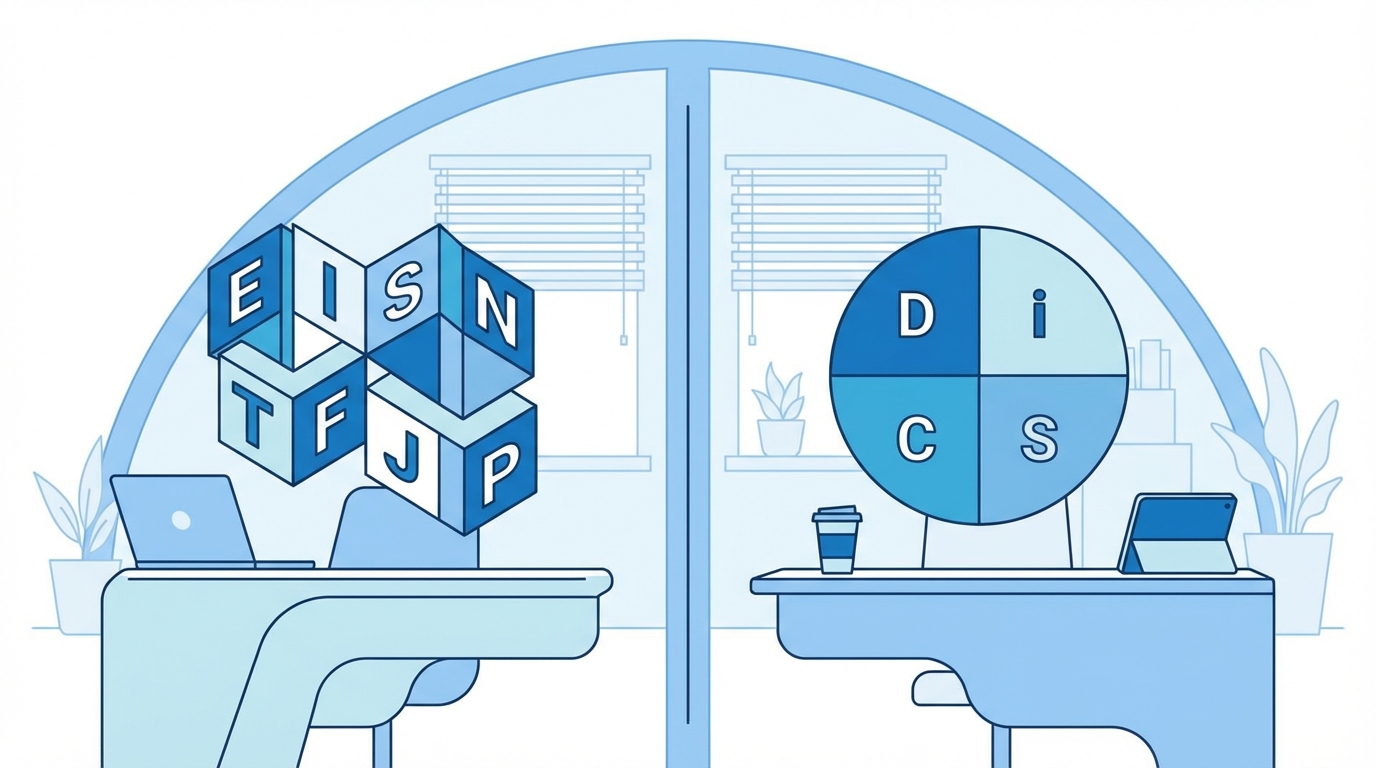
| Myers-Briggs (MBTI) | DISC | |
|---|---|---|
| What it measures | Cognitive preferences (how you think, decide, relate) | Behavior patterns (how you act and communicate) |
| Main use at work | Self-awareness, career fit, communication styles | Team dynamics, sales, leadership styles, conflict handling |
| Output | 16 personality types (e.g., ENTJ, INFP) | Four factors: Dominance, Influence, Steadiness, Conscientiousness |
| Complexity | Higher: multiple letters and combinations | Lower: simple quadrant model, easy to remember |
| Best for | Career coaching, introspection, development conversations | Practical day-to-day communication and management |
| Scientific support | Mixed; widely used, heavily debated | Mixed; grounded in behavior theory, still debated |
| Risk at work | Over-labeling people as a fixed “type” | Reducing people to one quadrant; stereotypes |
| Best business use | 1:1 coaching, leadership self-knowledge | Team workshops, sales training, conflict sessions |
Most teams grab personality tests because they are tired of miscommunication, slow projects, and weird conflict that no one talks about. You want people to understand each other faster. You want fewer “why did they send that email?” moments. Personality tools like Myers-Briggs and DISC can help with that. They can also waste time if you use them like a horoscope. The difference between those two outcomes is how you think about them, not which logo you pick.
The real value is not the test result. The real value is the conversation you create around the result.
If you treat Myers-Briggs and DISC as labels, you shrink your people. If you treat them as lenses, you expand how your team thinks about behavior, motivation, and conflict. In practice, both tools can work. Each leans toward a different use case in the workplace. So the key question is not “which is better?” but “what problem are you trying to fix at work?”
Let us break this down in a way that helps you pick, roll out, and use these tools so they actually change how your team works on Monday morning.
What Myers-Briggs and DISC Actually Measure
You cannot use a tool well if you do not understand what it is measuring. On the surface, both tests look similar: online questions, short report, some letters or colors. Underneath, they try to capture different layers of who you are.
Myers-Briggs: Preference, Not Skill
Myers-Briggs Type Indicator (MBTI) is built around four preference pairs:
1. Extraversion (E) vs Introversion (I)
2. Sensing (S) vs Intuition (N)
3. Thinking (T) vs Feeling (F)
4. Judging (J) vs Perceiving (P)
You end up with a 4-letter type like ENFP or ISTJ.
The key word here is “preference”. This is not about what you can or cannot do. It is about what feels natural. You might be an introvert who leads big meetings well. Or an extravert who loves quiet research. The test is not measuring talent. It is guessing where your energy usually goes.
MBTI is like your default setting, not your only setting.
In the workplace context, that means:
– An “I” can still sell or present. They might just need more recovery time.
– An “F” can make tough calls. They might weigh impact on people more.
– A “P” can hit deadlines. They might just resist rigid schedules.
If you treat MBTI as a talent score, you misread it. It is closer to a map of mental habits.
DISC: How You Show Up Behaviorally
DISC does not care much about your inner world. It cares about what other people can see: your behavior in common situations.
DISC breaks this into four factors:
– D: Dominance
– I: Influence
– S: Steadiness
– C: Conscientiousness
Instead of 16 types, you get a profile that shows your mix of these four.
High D: direct, decisive, results focused.
High I: social, persuasive, people focused.
High S: calm, patient, support focused.
High C: detailed, careful, quality focused.
This is very useful in the workplace because this is what your colleagues feel from you in meetings, calls, and emails. It gives teams a simple language for behavior.
DISC is less “who am I deep down?” and more “what do people experience when they work with me?”
Technically, this is not always clean. Behavior shifts by context. Stress, power dynamics, and culture all shape it. Still, for daily work, this clarity helps.
Where Myers-Briggs Shines at Work
You get the most from MBTI when the focus is awareness, reflection, and career direction, not just behavior hacks.
Self-awareness for Leaders
Leaders often overestimate how clear they are. They think their team understands their decisions, tone, and priorities. Many times they do not. MBTI can expose blind spots.
For example:
– An ENTJ leader might move fast, think big picture, and sound blunt. MBTI can help them see that their “clarity” can land as pressure for S or F types.
– An INFP leader might hesitate to give direct feedback, because they feel every emotion in the room. Their type report can give language for that tension.
With that language, you can ask better coaching questions:
– “Where does your type help you as a leader here?”
– “Where does your type overplay itself under stress?”
– “What is one behavior you want to flex this quarter?”
It slows down autopilot. That alone can change a team.
Career Conversations and Role Fit
MBTI can support career paths, if you treat it as a clue, not a script.
For instance, an ISTJ might feel drawn to roles with structure, data, and continuity. An ENFP might feel drawn to roles with change, ideas, and future focus.
The risk is when you say:
– “You are an introvert so you should not go into sales.”
– “You are a perceiver so you cannot handle project management.”
Those statements are wrong. The better way is:
– “Given your type, what part of this role will feel natural?”
– “What part will stretch you the most?”
– “What systems do you need to make that stretch sustainable?”
Use MBTI to open the career conversation, not close it.
Improving Communication at a Deeper Level
MBTI helps teams understand how people process information and make decisions.
Think about this:
– Sensing types like concrete facts, step-by-step logic, and proven methods.
– Intuitive types like patterns, concepts, and future scenarios.
So when a manager who is high N sells a new idea with big vision but no detail, S types will quietly worry. They will not resist the idea. They will just not trust it yet.
In a workshop, letting people talk about their S/N and T/F preferences creates moments like:
– “Oh, that is why you always ask for more data.”
– “Now I see why you ask about how people feel in every meeting.”
Those “now I get you” moments can reduce friction for months.
Where DISC Shines at Work
DISC is more behavior and communication oriented. It lives close to the surface. That makes it practical in fast paced teams where people do not want theory; they want scripts they can use this afternoon.
Sales and Client-facing Teams
Sales leaders like DISC because it links styles to observable signals.
Example:
– High D clients: talk fast, get to the point, want options and control.
– High I clients: like stories, small talk, and visible enthusiasm.
– High S clients: prefer calm, trust, and stability over risk.
– High C clients: ask many questions, want proof and detail.
With DISC, a sales rep can adjust in real time:
– With D: shorter pitch, strong outcomes, next step clearly framed.
– With C: longer pitch, more data, clear method and risk coverage.
You are not changing your values. You are changing your language.
Day-to-day Team Communication
DISC gives teams a simple shorthand.
You might hear:
– “I am high D, so just give me the bottom line first.”
– “I am high S, I need a bit more time to process that change.”
– “He is heavy C, so double-check the numbers before you bring it.”
Is it perfect? No. People are more complex than one letter. Still, this vocabulary cuts down on misread behavior, especially across roles.
Think of a high D manager and high S team member:
– Manager: sees short replies as “efficient.”
– Team member: experiences them as “cold” and “not open.”
When they both see their DISC profiles, they can say:
– “Now I see I come off harsher than I think.”
– “I see I sometimes wait too long to speak up.”
That kind of talk is rare without a structured prompt.
Conflict Styles and Recovery
Conflict at work is less about content and more about style. DISC is front row in that space.
Roughly:
– D under stress: more direct, maybe aggressive.
– I under stress: more emotional, maybe dramatic.
– S under stress: more withdrawn, might avoid hard topics.
– C under stress: more critical, might nitpick.
If your team has done DISC, you can de-personalize conflict:
– “My D spiked there, I pushed too hard.”
– “My C was in full control, I focused on details not people.”
This gives teams a safer way to talk about episodes that would otherwise stay under the surface.
Strengths and Limits of Myers-Briggs in the Workplace
Every tool has edges. Knowing those edges helps you use it with more skill.
Strengths of MBTI at Work
1. Shared language for cognitive diversity
MBTI gives teams a structured way to talk about differences in thinking. That helps you defend diverse voices.
Instead of “Why can you not just make a decision?” you get “I see your NFP mix needs more options on the table before you commit.”
2. Useful for long-term self-development
Because it touches deeper preferences, MBTI supports processes like:
– Leadership programs
– Coaching journeys
– Long-term career mapping
3. Normalizes introversion and reflection
In many business cultures, extraversion gets rewarded. MBTI can validate quieter strengths. An introvert can say: “My best thinking comes in writing.” A good manager can then shape meetings and follow-ups around that.
Limits and Risks of MBTI at Work
1. Type labeling and bias
People like labels. MBTI labels feel neat and tidy. That is the danger.
You might hear:
– “We need an ENTJ for this role.”
– “She is an INFP, she will hate operations.”
These jump from preference to prediction too fast. You start blocking growth because a report told you a letter.
2. Questionable stability
Many people get different MBTI results across time. Mood, instructions, and context change answers. That does not make it useless. It just means you should treat the type as a working hypothesis, not a blood type.
3. Overcomplication
16 types, cognitive functions, stacks. This can get heavy. Some teams enjoy the detail. Many do not. If your organization hates models and theory, MBTI can feel distant from real work.
Strengths and Limits of DISC in the Workplace
Strengths of DISC at Work
1. Very practical and memorable
Four letters. Simple graphs. That simplicity is not a bug. It is the point.
Teams often remember their DISC info months later and use it in:
– 1:1 talks
– Feedback sessions
– Project kickoffs
2. Strong fit for roles with clear interactions
DISC maps well to:
– Sales
– Customer service
– Account management
– Team leadership
You can tie behavior shifts directly to performance metrics.
3. Fast to teach and roll out
You can run a half-day workshop and people walk out with:
– A basic map of their style
– A clear sense of others’ styles
– A few scripts for adapting communication
For busy teams, that is appealing.
Limits and Risks of DISC at Work
1. Oversimplification
Four letters cannot capture the depth of a human. If you take DISC too literally, you end up with stereotypes:
– “He is D so he does not care about people.”
– “She is S so she will avoid conflict forever.”
Real people adapt. Roles change them. Context matters.
2. Over-focus on behavior, not motive
DISC shows how someone tends to act. It says less about why. That can limit coaching. To shift behavior long term, you need to know the fear, value, or belief under it.
3. Risk of using it as a control tool
Some managers use DISC to “handle” people rather than understand them:
– “Use I style to get her on board.”
– “Do not bother him, his C style makes him stubborn.”
You are then using people as pieces, not partners. Over time, that kills trust.
Which Tool Fits Which Workplace Goal?
Before choosing, ask a simple question: what are you trying to change?
If your goal is better team communication
Both MBTI and DISC can help. The choice depends on what kind of communication issues you see.
Patterns like:
– “We talk past each other in meetings.”
– “Some people feel ignored or steamrolled.”
– “Feedback often lands badly.”
If your culture likes concrete behavior tips and quick applications, DISC probably fits better. If your culture already engages in coaching, reflection, and personal growth, MBTI can take you deeper.
If your goal is role fit and career paths
MBTI often helps more here because it highlights:
– What energizes someone
– How they like to decide
– Whether they prefer variety or structure
You can combine MBTI with role mapping. For example:
– Roles that suit heavy S and C: quality assurance, finance, certain operations.
– Roles that suit high N and F: product, design, coaching, development.
Again, this does not mean “type equals job.” It just gives clues for job crafting. You can adjust tasks within a role so that more time goes toward natural strengths.
If your goal is smoother sales and customer interactions
DISC fits more clearly here. The direct link between style and observable client behavior is helpful.
Sales coaching can cover:
– How to spot a client’s probable style within the first minutes.
– How to adapt your pace, questions, and content to that style.
– How to handle stress responses across styles during negotiation.
You can also apply this in customer service. For instance, training scripts can include:
– With D callers: shorter empathy phrases, quicker action steps.
– With S callers: more reassurance, step-by-step guidance.
Over time, this can shift customer satisfaction and retention.
How To Actually Use These Tools Without Creating Boxes
The biggest risk with any test is that it becomes an excuse.
“You know me, I am just a D.”
“My type is P, I cannot plan that far.”
You want the opposite. You want language that invites growth.
Principle 1: Type is description, not destiny
Treat every report as a snapshot, not a sentence.
Encourage questions:
– “Where does this feel true?”
– “Where does this feel off?”
– “How has this shifted across your career?”
This also reduces resistance. People who hate labels can relax when they see that you are using the tool with flexibility.
Principle 2: Pair awareness with experiments
Insight alone does not change behavior. Pair each type insight with a small action.
Examples:
– MBTI: An ENFP sees they sometimes jump between ideas. Their action: for the next three meetings, they will summarize one clear decision at the end.
– DISC: A high D manager sees they cut people off. Their action: in 1:1s this week, they will ask one extra question before giving an answer.
This keeps the focus on behavior, not theory.
Principle 3: Share responsibility across the team
Personality work fails when it is one-sided. For example, when everyone must adapt to the CEO’s style.
The healthier setup: everyone owns both expressing and adjusting:
– “Here is my style. Here is how I might frustrate you.”
– “Here is what I am willing to try to adjust.”
– “Here is what I ask from you while I work on this.”
Personality language becomes a shared toolkit, not a power move.
Designing a Myers-Briggs Workshop That Feels Real
If you choose MBTI, a thoughtful first session sets the tone.
Step 1: Frame it as exploration, not evaluation
Make it clear the test is:
– Not for hiring
– Not for promotion decisions
– Not a performance score
Ask people to treat their result as a starting point for self-reflection, not a fixed identity.
Step 2: Spend more time on stories than letters
The magic does not sit in the four-letter code. It sits in the stories.
Prompt questions like:
– “Tell us about a time your E or I preference really helped you.”
– “Tell us about a time your T or F side created conflict at work.”
– “Where do you notice tension between your J/P style and company culture?”
Encourage people to keep it honest, not polished.
Step 3: Turn insights into team agreements
Have each team answer:
– “Given our mix of types, what do we need in meetings?”
– “How will we help the quieter voices speak up?”
– “What rhythm of communication fits this team best?”
Then write 3 to 5 simple agreements. For example:
– “We send agendas at least 24 hours before key meetings.”
– “We leave 5 minutes at the end of meetings to confirm decisions and next steps.”
– “We allow written input for big decisions, not just verbal.”
These small rules link personality insight to real behavior change.
Designing a DISC Workshop That Drives Daily Change
If you pick DISC, aim for practical shifts.
Step 1: Map the team visually
After everyone has their profile:
– Put up a large DISC quadrant chart.
– Have people place their names where their style sits.
Now you can see:
– Are we heavy D/I with little S/C?
– Do we have many S/C in support roles and mostly D/I in leadership?
This reveals bias. Many organizations reward certain behavior styles and underuse others.
Step 2: Practice style-switching live
Do roleplays where:
– A high D must pitch an idea to a high C using C-style language.
– A high I must give feedback to a high S using S-style pacing.
Then ask:
– “What felt forced?”
– “What actually worked?”
– “What might you try in your next real conversation?”
You do not need perfect acting. You just need people to try something new and talk about it.
Step 3: Create situation-specific guides
Have small groups create quick guides:
– “How to give feedback to each style.”
– “How to sell a new process to each style.”
– “How to share bad news with each style.”
Keep them short. One or two sentences per style per situation. Share them after the session.
People forget general theory. They remember “how to talk to D when a deadline moves.”
Combining Myers-Briggs and DISC Without Confusing Everyone
Sometimes teams want both tools. It can work if you keep roles clear.
Use MBTI for depth, DISC for rhythm
A simple division:
– Use MBTI in coaching, development plans, career talks.
– Use DISC in day-to-day communication, sales, and conflict work.
You can think:
– MBTI: inner preferences and longer-term growth.
– DISC: outer behavior and near-term adaptations.
You might, for example, use MBTI in a yearly leadership offsite, then use DISC in quarterly team workshops.
Translate one language into the other carefully
There is some correlation between MBTI and DISC patterns, but it is not clean. Try not to force neat conversions like “all ENTJs are high D.” Reality does not follow that rule.
Instead, help people see both as lenses:
– “Your MBTI type hints at how you like to think and decide.”
– “Your DISC style hints at how others usually experience you.”
Then ask:
– “Where do these two pictures match?”
– “Where do they feel different?”
– “Which one feels more useful for your current challenges?”
Let each person decide what is most helpful for them right now.
Using Personality Tests as a Founder, Manager, or Solo Operator
If you run a small business or you are still solo, personality tools can still support you.
As a founder or manager
You can use MBTI and DISC to:
– Understand why certain tasks drain you.
– Design your day so your best energy hits the most important work.
– Hire people whose style complements, not copies, your own.
For example, a founder who is high D/I with an ENFP type might love vision, selling, and new ideas. They might avoid:
– Detailed process building
– Documentation
– Careful risk assessments
Knowing this, you can:
– Hire or contract C/S heavy people to own those zones.
– Respect their need for time and detail.
– Shield them from last-minute idea changes when possible.
As an individual contributor or solo professional
You can treat your results as a manual for self-management:
– What kind of environment do you think best in?
– What kind of feedback helps you improve instead of shut down?
– What routines keep you from overusing your type strengths?
For instance:
– A high I might set limits on unstructured social time so they still have focus hours.
– A high C might schedule “good enough” deadlines to stop endless tweaking.
These are small adjustments, but they compound over months.
Red Flags When Using Personality Tests at Work
There are a few patterns that signal trouble.
Using results in hiring and firing
If you gate roles by type or DISC style, you shrink the talent pool and increase bias. Better:
– Assess behavior and performance in context.
– Use personality info as one small data point for onboarding, not selection.
Public shaming or jokes based on style
Light jokes can turn into labels. When people feel mocked for their type, they stop engaging with the tool.
Set simple standards:
– No using type or style as an insult.
– No blaming behavior on type as a way to avoid feedback.
– No diagnosing people who have not taken the test.
One-off workshops with no follow-up
One afternoon with colored charts will not shift culture. To keep value alive:
– Bring type or style into 1:1s.
– Revisit it at project kickoffs.
– Add one or two prompts into performance reviews.
For example:
– “How did your style help and hinder you this quarter?”
– “Which behavior flex did you practice since our last review?”
Even minor follow-up creates continuity.
Choosing Between Myers-Briggs and DISC For Your Workplace
Rather than chase the “right” tool, ask four simple questions:
1. What specific behavior at work do you want to change?
2. How much time and energy will your team give to this?
3. Does your culture lean more toward reflection or action?
4. Who will own this beyond the first workshop?
If you want faster, clearer communication with low training time, and you have practical managers who like tools they can pick up quickly, DISC is probably a better first move.
If you want deeper self-awareness, better leadership development, and you have people who will engage with reflection and coaching, Myers-Briggs likely fits better.
Both tools can support growth if you treat them as starting points, stay curious, and keep the focus on real behavior at work, not letters on a slide.