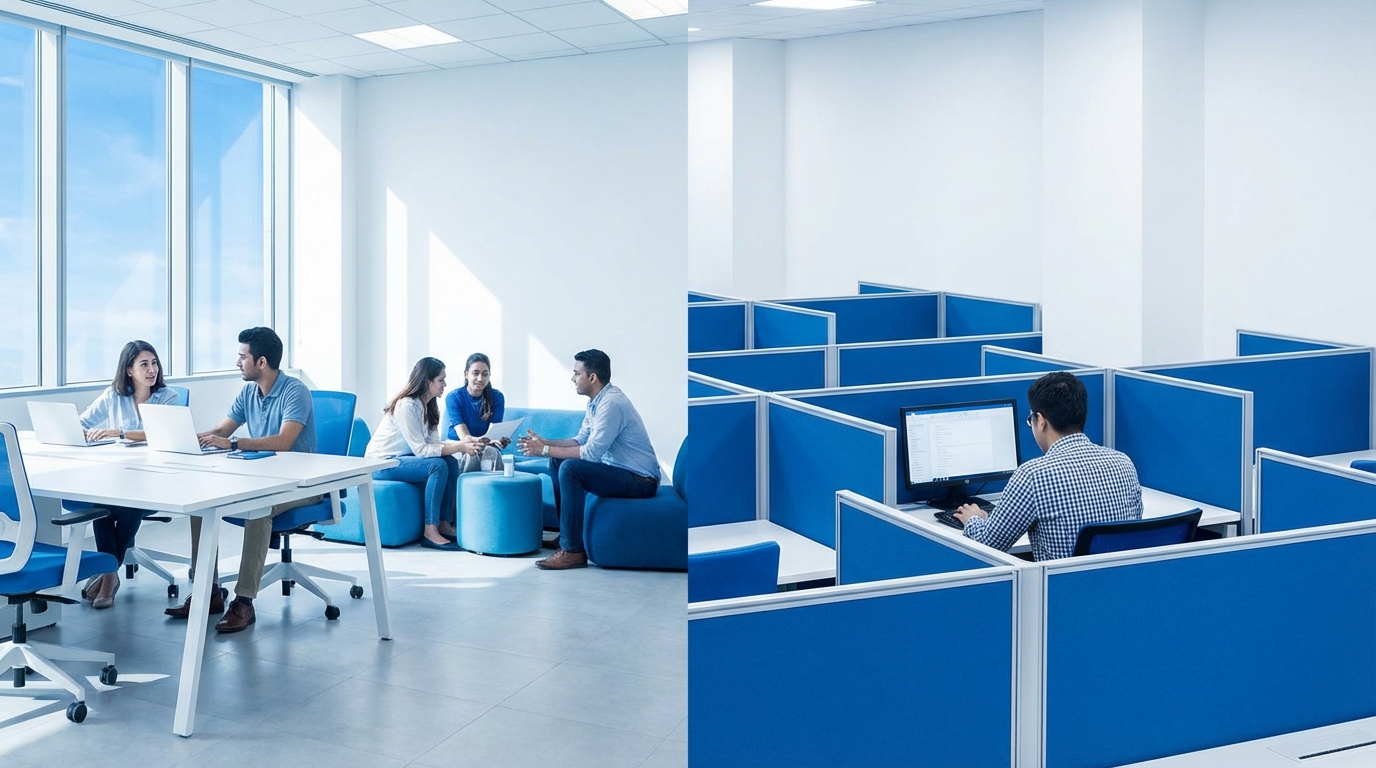
| Open Plan | Cubicles | |
|---|---|---|
| Best for | Collaboration, fast feedback, creative brainstorming | Deep work, focus, sensitive tasks, complex thinking |
| Main benefit | Easy communication and visibility | Privacy, fewer distractions, control over environment |
| Main drawback | Noise, interruptions, low concentration | Less spontaneous interaction, risk of silos |
| Best for team types | Sales, support, social media, product pods | Engineering, writing, finance, legal, strategy |
| Impact on productivity | Good for quick coordination, weak for deep focus | Strong for deep focus, slower for fast back-and-forth |
You are not really choosing “open plan vs cubicles.” You are choosing what type of work you want your people to do well, day in and day out. If you get that match wrong, you pay for it in missed deadlines, half-baked work, and quiet frustration that slowly shows up in your P&L. The layout around you shapes how you think, how you talk, and how brave you feel speaking up. So this is not about office furniture. It is about how you run your business and how you live your workday.
Productivity is not a desk shape problem. It is a work design problem that happens to show up in your floor plan.
The real question is not “Which is better?” but “Which is better for this task, for this person, at this moment?”
If you copy another company’s office layout, you also copy their problems, not just their photos on LinkedIn.
Any layout that ignores focus, energy, and human comfort will quietly kill productivity, no matter how trendy it looks.
You do not need to pick a side. You need to build a workspace that can switch modes as fast as your work does.
Why open plan took over (and what it gets right)
Open plan offices exploded because they are cheaper per square foot, they photograph well for recruiting, and they send a clear visual signal: “We are open. We talk. We move fast.”
From a business lens, that makes sense. Fewer walls. More people in less space. Fast communication. And for some types of work, that is a real gain.
Where open plan actually helps productivity
Think about teams that live and die by fast response:
– Sales floors where reps need to hear each other’s calls and energy.
– Support teams coordinating responses and learning from each ticket.
– Social media or marketing teams moving on campaigns with tight timelines.
– Early-stage product squads testing ideas, fixing issues, shipping fast.
In these cases, open plan helps in a few ways:
You see problems forming in real time
You can see who looks stuck, who looks free, who has five people around their screen. That visual information changes how you act. You walk over, you help, you jump in a quick huddle. No calendar invite. No back and forth.
Micro-conversations speed up decisions
Think of all the “Got a second?” questions that avoid a 30-minute meeting. In open spaces, those conversations are natural. You overhear context. You join only when needed. You cut cycles of email.
Faster learning for juniors
People new to the role get to hear how experienced people talk to clients, solve problems, handle objections. They pick up patterns just by being in the room. That is hard to replicate with walls and headphones.
Energy and urgency
Group energy is a thing. When everyone is talking to customers, shipping features, closing deals, the room carries a certain push. You sense pace. You match it. That can raise output, at least for work that is shallow and reactive.
So for coordination-heavy, collaboration-heavy work, open plan has a real upside. Technically, not for every person on those teams, but as a system, it helps.
Where open plan quietly destroys output
The problem is that a lot of high value work in your business is not reactive. It is not about quick chats. It is about deep thinking.
– Writing a proposal that wins or loses a six-figure contract.
– Designing a feature that users will either love or ignore.
– Drafting contracts where one sentence can cause months of trouble.
– Building financial models and forecasts.
– Coding core systems.
This work needs stretches of concentration. Not perfect silence. But a clear mind. A sense that you will not get interrupted every few minutes.
Here is what happens with open plan:
The interruption tax
People in open spaces get interrupted more. Sometimes through direct taps on the shoulder. Sometimes through noise. Sometimes through overheard conversations that trigger side thoughts. Each interruption forces your brain to unload and reload context. That reload can take many minutes.
Context switching is expensive
If you need to hold a complex idea in your head, every switch to answer a “quick question” forces your brain to rebuild that structure. After a while, people stop doing deep work not because they do not want to, but because it feels exhausting to restart.
People hide behind headphones
Headphones become the new walls. You get a floor that looks open, but feels closed. People turn to chat or email because they hesitate to talk to someone wearing big headphones. So the original promise of “easy communication” starts to fade.
More communication, less focus
You get more conversations, but not always better ones. More stand-ups. More “syncs.” A bit more talking, a bit less thinking. Over time, work quality can drop while people feel like they are “collaborating” a lot.
Psychological pressure
In open spaces, people feel watched. Screens are visible. Body language is visible. Some people push themselves to look busy rather than be productive. That creates stress, not better work.
So yes, open plan can lift energy and coordination. It also pulls down concentration, which matters more than we tend to admit.
What cubicles really do to productivity
Cubicles were never cool. They feel corporate. They remind people of old office photos. So companies rush to remove them without asking what they actually did well.
Cubicles give people partial control. A bit of quiet. A sense of “my space.”
How cubicles help people get more done
Lower noise, lower mental load
Walls block sound a bit. Not fully. But enough to cut random chatter. Less noise means less mental scanning. Your brain has fewer external inputs to process, so it can go deeper into a task.
Visual boundaries
Not seeing constant movement helps more than most managers think. Every person walking by is a micro-stimulus. It nudges your attention, even if you do not look up. With a partition, that load drops.
Easier to personalize
People pin notes, checklists, process maps, inspirational photos, personal reminders. This looks minor, but these cues help memory and focus. They make it easier to pick up where you left off. It feels like a cockpit, not a hallway.
Safer space for tough tasks
Hard phone calls. Sensitive HR work. Numbers that need care. A half-wall is not perfect privacy, but it gives people enough of a bubble to feel safe focusing on harder tasks. They know fewer eyes are on them.
More control over interruption
Someone has to step into your space. That small physical step adds a mental filter. People think twice before breaking your focus. They might send a message instead and let you respond when you are ready.
All this adds up. Unit by unit, cubicles support deep work. Especially for roles that create long-term value.
Where cubicles hurt productivity
You do not get the benefits without trade-offs.
Less spontaneous help
If walls are too high, you do not see when someone is stuck. You do not see when they are free. People hesitate to walk in. So problems sit for longer. Misunderstandings stay hidden.
Slower knowledge spread
In open spaces, one question sparks a five-minute group conversation that clears up confusion for many. In cubicles, that becomes a one-to-one chat that others never hear. Learning spreads slower.
Risk of isolation
Some people need human contact to stay engaged. If they sit in a cube all day, they drift. They check more social media. They feel less part of the team. That drags on energy, which then drags on output.
“Us vs them” layouts
When cubes sit in one area and leaders sit in glass offices far away, the message feels clear: different world, different rules. That hurts trust. When trust drops, people communicate less openly, and that hits speed and quality.
Cubicles are good at protecting focus. They are weak at sparking fast, informal connection. If your culture already has poor communication, cubes can make that worse.
The myth of the “perfect” office layout
Every time a new office trend shows up, people talk like it will fix productivity forever. Standing desks. Hot desking. Phone booths. Bean bags.
Most of that thinking skips one basic truth:
Different work needs different environments.
The same developer who loves team whiteboard sessions also needs three quiet hours of deep coding. The same founder who thrives in a buzzing open area for part of the day might need silence to write a strategy doc in the afternoon.
So when people ask, “What actually boosts productivity, open plan or cubicles?” the honest answer is a bit inconvenient:
You need both modes available. You need your space to switch between “talk mode” and “focus mode” without drama.
Think in modes, not furniture
Instead of asking “Open or cubes?” ask:
– What tasks need near-zero interruption?
– What tasks need quick back-and-forth?
– When during the day do those tasks usually happen?
– Who needs more silence than others?
– Who gains energy from people around them?
Then design for three primary modes.
Focus mode
Work that needs depth, like analysis, writing, designing, coding, planning. People in this mode need fewer visual and audio triggers and a clear signal that they should not be disturbed.
Collaboration mode
Work that needs exchange, like brainstorming, war rooms, stand-ups, pairing on tasks, live problem solving. Here, easy eye contact and movement help.
Recovery mode
People need short breaks to reset mental energy. A place to walk, get coffee, step outside, breathe. Without guilt.
You do not need a huge office or massive budget to support these. You do need to be intentional.
Practical ways to combine open plan and cubicles
Let us get concrete. This is where you can actually change how your team works.
1. Create clear “focus zones”
If you have cubicles, that is a natural focus zone. If you only have open plan, you can still carve out focus areas.
A focus zone is any area where the social rule is: “No casual interruptions. Low voice. Short calls only if urgent.”
You can:
– Put quieter, deeper-work teams in a section with more partitions.
– Use bookshelves, plants, screens to block line of sight in certain rows.
– Mark an area as “Quiet work” with simple signage and stick to it.
– Give people a way to signal “do not interrupt” at their desk, like a desk flag or small sign.
The key is the social contract. People must respect the zone. That gives you most of the benefit of cubicles even if the walls are not high.
2. Build “collab corners” instead of constant open chaos
Instead of making the whole floor one big conversation area, cluster collaboration spaces.
You can use:
– A few areas with grouped desks facing each other.
– High tables near whiteboards for quick huddles.
– Benches where people can sit down with laptops for a short session.
When teams need to talk, they move to these areas. That keeps the noise concentrated, not spread across the whole office.
This is where open plan shines, but now you control where and when that energy spills out.
3. Rethink meeting rooms
Most meeting rooms are either too big or always fully booked. They end up being used for everything.
You can improve productivity more than you think by adding or repurposing a few small spaces:
– 1-person focus rooms for deep work or calls.
– 2-person rooms for quick syncs.
– 4-person rooms for light collaboration.
These do not need fancy furniture. They just need a door that closes and some basic sound dampening. If you have unused corners or storage, some of that can become a small focus room.
This takes pressure off both open areas and cubicles. People have somewhere else to go for noise or silence.
4. Use time, not just space
If you cannot change your physical space much, change how you use time.
– Block “quiet hours” for the whole company or team. For example, 9 to 11 every morning is focus time. No internal meetings. No “got a minute?” taps. People treat it like a rule.
– Stack meetings in the afternoon so mornings stay clear.
– Encourage teams to follow “maker vs manager” time. Makers (creators, coders, analysts) get larger blocks of uninterrupted time. Managers stack shorter meetings.
This matters as much as walls. A cubicle does not help much if your calendar is full of scattered 30-minute calls all day. Open plan edge drops a bit if you protect real focus blocks.
5. Clarify communication norms
One big hit to productivity is not the layout itself, but how people use it. If every question becomes an instant desk visit, productivity drops no matter what your desk looks like.
You can:
– Default to async: send a message first. If it is urgent, say so clearly.
– Use agreed tools for different levels of urgency. For example, chat for normal questions, a specific channel or tag for urgent issues, email for non-urgent.
– Normalize slower responses during focus time. People should not feel pressure to reply within minutes unless something is truly critical.
When people trust that they can go deep without constant pings, both open plan and cubicles work better.
Different roles, different needs
Your office is not one type of worker. Each role has a different relationship to noise, visibility, and interruption. If you try to treat everyone the same, you end up helping no one.
High-collaboration roles
Sales, customer support, certain parts of marketing or operations live in constant communication.
They benefit from:
– Closer seating in open pods.
– More visible spots near shared spaces.
– Short walking distance to others they collaborate with daily.
– Lightweight areas where they can stand up, brainstorm, return to desk quickly.
For them, cubicles can sometimes slow the type of real-time flow their work needs. They still need access to focus spaces, but maybe not all day.
High-focus roles
Engineering, finance, legal, design, writing, research need more uninterrupted time.
They benefit from:
– Cubicles or deeper focus sections.
– Seating away from loud entry areas or busy paths.
– Easier access to small private rooms for deep work.
– Fewer ad hoc interruptions from teams with urgent, reactive work.
Putting a developer next to a ringing sales floor makes that developer look slow. In reality, you just buried them in noise.
Leaders and founders
You might be tempted to pick the nicest quiet office for yourself and call it a day. That sends a signal: “My focus matters. Yours does not.”
Instead, you can:
– Spend part of your day in open space for visibility and quick touch points.
– Block part of your day in focus rooms or a closed office for deep work.
– Be open about this rhythm so others feel allowed to protect their focus too.
Leaders set the norm. If you answer every message within 60 seconds, your team will feel they must do the same. No layout will fix that.
The hidden productivity drivers people ignore
Office debates often stay stuck on walls and desk shapes. There are a few quieter factors that matter as much.
Psychological safety and voice
If people do not feel safe speaking up, an open plan will not create collaboration. It will create quiet resentment in a visible room.
People need to feel:
– Safe asking questions.
– Safe saying “I need to focus right now.”
– Safe saying “This setup is not working for this type of task.”
If someone in power dismisses these concerns, people shut down. They stop sharing ideas. They stop raising issues early. That is one of the most direct hits to productivity, and it has nothing to do with cubicle height.
Noise quality, not just noise level
Some sounds are more distracting than others. Human speech grabs attention more than steady white noise.
So:
– A constant, low background sound from air systems or white noise machines can make occasional speech less sharp and distracting.
– Soft materials (carpet tiles, panels, fabric dividers) soak up echoes. Hard surfaces bounce sound around.
– A TV playing in the background is worse than quiet conversation in another corner.
You can do a basic walk test. Stand in different spots and just listen for 30 seconds. If you can clearly hear words from all across the room, your brain is doing extra work all day long.
Light, air, and comfort
A person who squints at a screen, freezes under a vent, or sits in a chair that hurts their back will not do their best work. They might not complain, but they will work shorter, more shallow bursts.
Simple improvements:
– Natural light where possible. Avoid putting people in dark corners all day.
– Adjustable chairs that support posture.
– Control over temperature where you can offer it, even small fans or heaters at some desks.
Open plans often put more people under the same conditions. Cubicles can sometimes hide poor conditions. In both cases, comfort is productivity.
Remote work changed the question
Many employees now know what it feels like to work alone at home, in a cafe, or in a coworking space. They have a lived sense of when they focus best.
That shifts the office conversation. People now compare your office not just to their last company, but to their best work-from-home day.
If someone does their best thinking at home but comes to the office for meetings, your design priorities change.
You can:
– Treat the office as a collaboration hub and a partial focus space, not the only place work happens.
– Encourage people to reserve office days for teamwork and use home days for deeper work.
– Give people some control over which days they spend in which environment.
This means you may not need a huge number of dedicated cubicles. You might need fewer, better focus options and stronger collaboration zones for the days people choose to commute.
Simple experiments to test what works
You do not have to guess. You can run small tests and watch what happens.
Experiment 1: Quiet mornings
For four weeks:
– Block 9 to 11 as “no internal meetings” across the company or team.
– Ask people to avoid casual interruptions during that window.
– Keep space the same.
Then ask:
– Do people complete more deep tasks?
– Do errors in complex work drop?
– Do meetings in the afternoon get shorter because prep work is better?
If yes, you just proved that time rules can lift productivity without new furniture.
Experiment 2: Pop-up focus area
Pick a section of your open office and turn it into a focus zone for a month.
– Add signs.
– Move a few partitions or shelves to reduce visual noise.
– Set a rule of low voices and no casual interruptions.
Watch:
– Does usage grow?
– Do teams start reserving it for heavy tasks?
– Do people report feeling less drained?
If it works, you can extend it. If not, you adjust without big sunk costs.
Experiment 3: Hot seats for collaboration
Create a few “collab desks” in a busier area.
– Anyone can sit there when they want to be more accessible.
– Mark them clearly.
– Encourage managers and cross-functional roles to use them for parts of the day.
This splits your space into visible “come talk” spots and quieter zones. That alone can balance the best parts of open plan and cubicles.
What actually boosts productivity, in practice
If you put all this together, productivity tends to rise when you:
– Give people one clear place or time for deep, uninterrupted work.
– Give them one clear place or time for fast collaboration.
– Set simple, respected rules around interruptions and meetings.
– Match seating to the nature of the work, not to job titles.
– Let people have some choice and control over how they work.
Open plan helps collaboration if it is not forced on everyone, all the time. Cubicles help focus if they are not used to isolate teams and remove visibility.
The layout itself is the surface layer. Underneath, it reflects what you really value in your company:
– Do you value thinking time enough to protect it?
– Do you value communication enough to structure it, not just spread people in one big room?
– Do you trust people enough to give them some control?
If you design around those questions, you can mix open spaces and cubicles in a way that fits your business and your life. And productivity tends to follow.