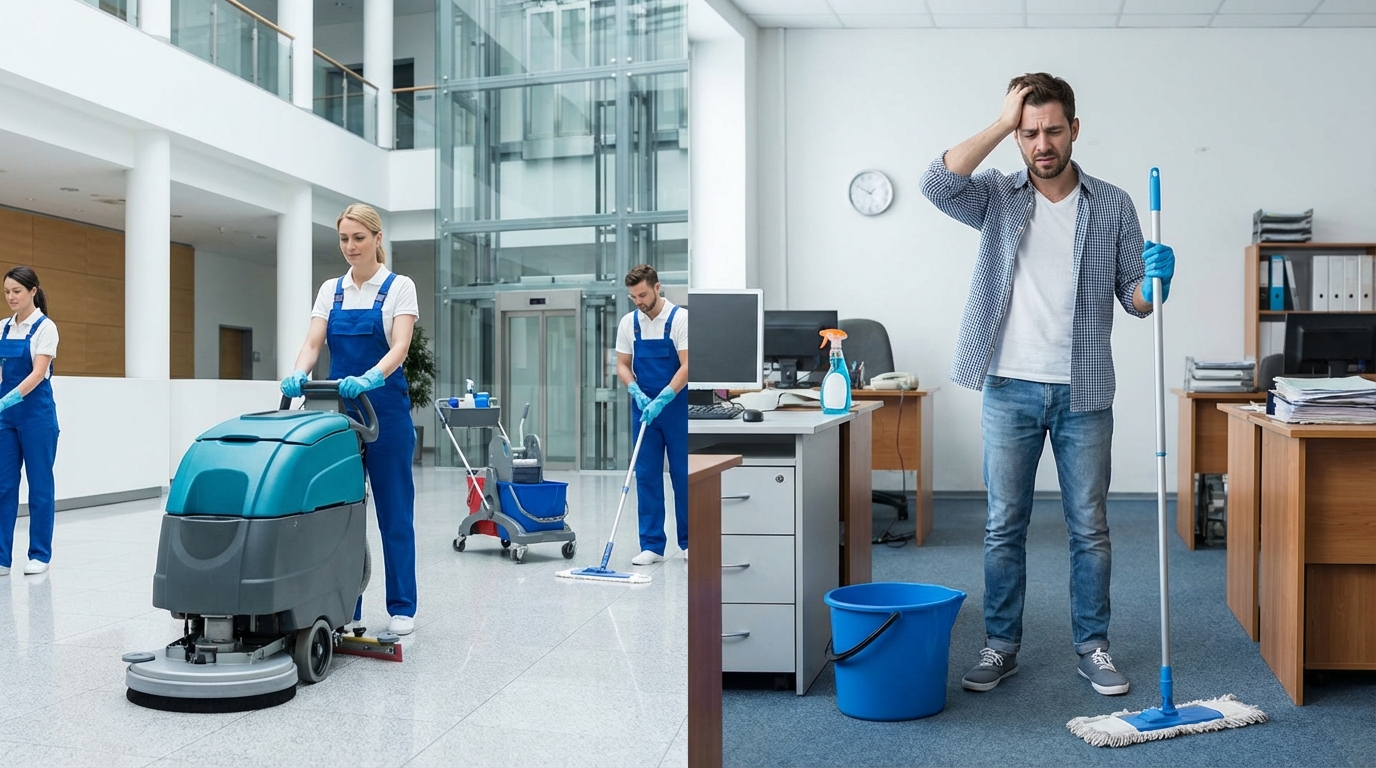
| Outsourced Janitorial | In-House Cleaning | |
|---|---|---|
| Upfront Cost | Low (service contract) | High (hiring, equipment, supplies) |
| Ongoing Cost Predictability | High (fixed or set monthly rate) | Medium (wages, benefits, turnover) |
| Control Over Staff | Lower | Higher |
| Quality Consistency | High with right vendor, variable at first | Depends on management and training |
| Flexibility for Growth | High (easy to scale hours/sites) | Low to medium (more hiring and setup) |
| Risk & Compliance | Vendor shares legal and safety burden | You own all HR, safety, and legal risk |
| Culture & Brand Fit | Needs work and clear expectations | Easier to integrate into team and values |
| Best For | Growing or multi-site businesses | Small, stable sites or special facilities |
You would think cleaning is a small operational detail. It is not. The choice between outsourcing janitorial services or keeping cleaning in-house changes your cash flow, risk, team culture, and even how clients see your brand. This is one of those quiet decisions that either supports your growth or keeps dragging on your time and energy. So you want to be deliberate here, not reactive.
Why this decision matters more than it looks
When people talk about growth in business and in life, they talk about strategy, sales, leadership, habits. Almost nobody talks about who cleans the bathrooms.
Yet your office, clinic, store, warehouse, or coworking space has a daily story written in dust, trash, smells, restrooms, and floors. That story affects:
– How safe your team feels
– How confident clients feel when they walk in
– How productive people are
– How much you get pulled into small fires
If your staff walks into a dirty kitchen every morning, they start the day slightly annoyed. They might not say it. But they feel it. Over a year, that small drag shows up in morale and behavior.
At the same time, you have a limited amount of energy. Every hour you spend managing mops, schedules, and supply closets is an hour you do not spend on sales, customer experience, or your own development. So this is not just an operations choice. It is about how you spend your focus.
The real costs: money, time, and mental load
Before we put outsourcing and in-house side by side, you need a clear picture of what cleaning actually costs, beyond paychecks or vendor invoices.
Direct financial costs
For in-house cleaning, your cost stack usually includes:
– Wages or salaries
– Employer taxes
– Benefits (even if basic)
– Equipment (vacuum, floor machines, carts)
– Supplies (chemicals, trash liners, paper goods, soap)
– Repairs and replacements
– Training time
For outsourced janitorial, your bill typically bundles most of this into a single contract rate. You pay a fixed monthly amount based on square footage, frequency, and scope.
People often think in-house is cheaper because wage x hours feels simple. In practice, once you include hidden layers, outsourced cleaning is often equal or lower for small and mid-size businesses, and sometimes higher for very large single-site operations.
Indirect costs that most owners skip
You also have soft costs. These are harder to measure, but they hit your growth.
1. **Management time**
With in-house staff, somebody on your team handles:
– Hiring and interviews
– Scheduling and coverage
– Corrective conversations
– Performance reviews
– Sick calls and last-minute no-shows
If that is you, that is leadership energy not spent on higher value work. If it is a manager, that is payroll you pay to run internal cleaning. You can ignore this cost on paper, but you still pay it.
2. **Turnover and recruiting**
Cleaning roles tend to have higher turnover. Not always, but often. That means:
– Reposting jobs
– Screening candidates
– Onboarding again
– Temporary drops in quality
Outsourced providers carry most of that churn for you. You feel it less, unless the vendor is unstable.
3. **Risk exposure**
With in-house cleaners you carry more exposure for:
– Workplace injuries
– Wrong chemical use
– Compliance with OSHA and local rules
– Harassment or misconduct cases
– Wrongful termination claims
Outsourcing shifts a part of this to the vendor. Not all of it, but quite a bit.
So when you compare, you want to look at the full picture, not just “hourly wage vs contract price.”
Outsourcing janitorial services: what you really gain and lose
Where outsourcing tends to shine
If you bring in a professional janitorial company, here is what usually improves first.
1. Predictable monthly costs
You negotiate a contract. You know your rate for the next 12 months or more. That helps planning. You do not get surprise overtime because someone had to stay late to deep clean.
You can also adjust scope: 3 days per week, 5 days, nights only, day porter plus nights. The pricing follows.
For most growing businesses, the biggest win with outsourcing is not saving money. It is buying predictability and freeing leadership attention.
That predictability lets you plan growth more calmly.
2. Better training and equipment without you owning it
Good janitorial firms bring:
– Trained teams who already know cleaning systems
– Standard procedures for different facility types
– Commercial-grade equipment
– Access to chemicals suited for your floors and surfaces
You do not have to figure out which floor machine to buy or which disinfectant is safe for a clinic vs office. They already learned that over many clients.
Technically, some vendors cut corners and under-train staff. That happens. So vendor selection matters more than the model itself.
3. Flexibility as your business changes
When you grow into a bigger space or open a second location, scaling an outsourced model is simple:
– Adjust square footage and scope
– Update the contract
– Vendor staffs for it
You do not have to handle extra hiring, uniforms, and supply stocking from scratch.
This is especially helpful if:
– You run multi-site retail or clinics
– You manage regional offices
– You have seasonal peaks
The vendor can add people, increase frequency, or pull back, while you keep one main relationship.
4. Shared responsibility for risk and compliance
Outsourced janitorial companies often:
– Carry their own insurance
– Train staff on safety protocols
– Keep up with regulations for chemicals and hazardous materials
– Have standard incident reporting processes
You still have a duty to provide a safe workplace. But some liabilities move to the vendor. That matters for peace of mind, especially if you have specialized spaces like labs, medical rooms, or food production.
Where outsourcing can frustrate you
This is not perfect. There are trade-offs that can drive you a little crazy.
1. Less direct control
The cleaning team does not work for you. They work for their employer. If you want someone replaced, you ask the vendor. You do not simply reassign them.
Small issues can also feel slower to fix. For example:
– The cleaner keeps missing one conference room
– Trash is collected later than you like
– Restroom supplies run low more often than you think they should
You can handle this with checklists, inspections, and clear feedback routes. But it is less direct than walking over to an employee and coaching in real time.
2. Culture and brand connection
With outsourced staff, you have to work a bit harder if you want them to feel part of your mission.
That matters because:
– They are seen by clients and visitors
– They affect the daily vibe in the office
– They hear and see what happens in your space
Many companies ignore janitorial teams. That creates a gap. The cleaners feel like outsiders. They do the minimum. They do not speak up about issues they see.
You can fix this partly by:
– Introducing them by name to your team
– Including them in some internal communication
– Treating them with the same respect as your staff
Even then, the emotional tie is different from an in-house team.
3. Risk of vendor mismatch
Not all janitorial vendors are equal. Some are great. Some are terrible. You might hit a rough one before finding a good fit.
Signs of a poor vendor:
– High staff turnover on your account
– Very slow response to concerns
– No clear inspection or quality control
– Vague answers about chemicals and safety procedures
Switching vendors is possible but adds friction. That transition period can hurt image and morale.
In-house cleaning: where it works and where it drains you
Now look at what happens when you bring cleaning inside your org.
Where in-house cleaning shines
1. Direct control and immediate feedback
With in-house cleaners:
– You set exact standards
– You design checklists
– You coach staff directly
– You adapt protocols quickly
See a missed spot in a lobby? You can talk to the cleaner within minutes. Over time, your preferences get baked into the way they work.
If your brand relies on a very specific physical experience, in-house cleaning gives you tighter control over every detail.
This is common in:
– Luxury retail
– High-end hospitality
– Specialized medical or lab spaces
– High-security facilities
2. Stronger culture integration
In-house cleaners:
– Join your meetings if you invite them
– Wear your uniforms
– Learn your values
– Build relationships with your team
They become part of the internal community. That feels good and can reduce small conflicts. People say thank you more. Cleaners feel respected. Communication is easier.
Culture integration also helps with:
– Confidentiality
– Respect for sensitive areas
– Awareness of key clients and internal rules
3. Potential long-term cost control for large, stable sites
For a single large facility with predictable needs, an in-house team can be cost-effective over several years, especially if:
– Turnover is low
– You negotiate good supply contracts
– You already have HR and training systems
You avoid vendor margins and lock in your own wage structure. For some industries, this matters a lot.
Where in-house cleaning becomes a drag
1. HR headaches and management burden
Cleaning staff need:
– Recruiting
– Onboarding
– Coaching
– Shift coverage
– Discipline when standards drop
If your managers are not used to leading frontline staff in these roles, they may struggle. Performance conversations can feel awkward. Standards might slip.
Over time, you end up with:
– Unclear expectations
– “We always did it this way” habits
– Bigger gaps between what you think is happening and what actually happens
That creates friction in the rest of the company.
2. Hidden costs and surprises
In-house looks simple at start:
– Hire 1 or 2 cleaners
– Buy some equipment
– Order supplies
After a while, you face:
– Equipment breakdowns
– Price increases on chemicals and paper goods
– Extra cleaning demands during flu season or outbreaks
– Unplanned overtime when someone calls in sick
These small shocks add up and can even exceed what an outsourced contract would cost, especially if your cleaners are part-time and have fewer benefits with less loyalty.
3. Limited flexibility when needs change
If your business:
– Moves to a new space
– Shrinks or grows fast
– Opens satellite offices
– Changes working hours
Your in-house cleaning structure has to change too. That means new hiring, shifts, or downsizing. None of that is simple.
An in-house team is less flexible across multiple sites. You cannot teleport a cleaner from Site A to Site B to cover a one-time event three cities away.
How this choice affects business growth
This is not only about clean desks. It is about growth capacity and your own life as a founder or leader.
Where outsourcing supports growth
Outsourcing tends to support growth when:
– You are scaling from one site to several
– You are entering new markets
– You need clear, stable cost structures
– Your team is already stretched
The reason is simple. Your leadership bandwidth is rare. Every extra direct report or extra function you own reduces your ability to push into new opportunities or deepen client relationships.
If cleaning is outsourced with a reliable partner, you gain:
– Fewer people to manage directly
– Simpler financial forecasting
– One lever to pull if something goes wrong (the vendor account manager)
That lets you focus on:
– Strategy
– Sales and marketing
– Service quality
– Team development
Cleaning itself will never be your strategic edge, but removing friction around cleaning can free your edge to show up elsewhere.
From a life perspective, this matters too. When your days are full of small problems, your creative energy shrinks. Offloading operational weight can give you the mental space for deeper thinking.
Where in-house supports growth
In-house cleaning can also support growth, just in a more focused way, if:
– Your physical environment is part of your brand promise
– You need tight control over access and security
– You operate in regulated or high-risk industries
– You have stable locations with long leases
In this case, the quality and consistency of cleaning help you stand out. For example:
– A boutique gym where every surface needs to feel flawless
– A dental practice where patients notice every detail
– A food production site with strict protocols
In these environments, your cleaning team is almost an operations team. They are part of your value proposition, not just support.
How this choice affects morale and culture
You cannot grow a strong business without a strong internal environment. Cleaning plays a subtle role here.
Signal of respect
A clean, well-maintained space signals:
– “We respect you.”
– “We care about your health.”
– “We pay attention.”
A messy or poorly cleaned space signals the opposite. That message reaches both your team and your visitors.
Whether you outsource or keep cleaning in-house, if quality drops, people subconsciously feel that drop as lack of care.
Relationships with cleaning staff
With in-house staff, relationships can deepen quickly:
– People know cleaners by name
– Casual hallway chats happen
– There is mutual familiarity
This leads to:
– More empathy
– More direct feedback
– A stronger sense of shared space
With outsourced staff, the relationship can still be strong, but it requires intention. If you treat them like ghosts who show up at night and disappear, you lose a silent ally in maintaining a positive environment.
Psychological ownership of the space
When your own employees clean, sometimes they take more ownership of the environment. They see messes as “our” problem, not “their” problem.
At the same time, this can backfire if people start saying, “That is not my job, the cleaner will do it.” This mindset can appear under both models, but you see it more often when the cleaning team feels invisible.
To support growth, you want a culture where:
– Everyone takes reasonable responsibility for shared spaces
– The cleaning team is respected, not treated as background
– Standards are clear and shared, not just someone’s personal preference
Key questions you should ask yourself before deciding
Before you land on one option, walk through some questions. Be honest with your answers. This is about how you run your business and your life, not about what sounds ideal in theory.
1. What is the real size and complexity of your space?
– Small office or studio with one restroom
– Medium office with multiple floors
– Retail floor with heavy foot traffic
– Medical, lab, or food facility with strict rules
– Multi-site offices in different cities
As complexity grows, outsourced cleaning often provides more benefit. For very small and simple spaces, in-house or even partial self-cleaning can work, at least early on.
2. How fast are you growing or changing?
If you expect:
– Relocations
– New leases
– Rapid headcount changes
– Experiments with new office formats
Then you want flexibility. Outsourcing supports that more easily. If your space is stable and long-term, in-house becomes more viable.
3. How strong is your internal management structure?
Do you have:
– A reliable operations manager
– HR processes that work
– Time and ability to manage frontline staff
If yes, in-house may fit. If not, an outsourced model can prevent your days from being pulled into every scheduling and quality issue.
4. What is your appetite for risk and compliance work?
Ask:
– Are we ready to own safety protocols for chemicals and equipment?
– Do we want to keep up with new cleaning standards, especially health-related?
– How will we handle workplace injuries or disputes in a cleaning team?
If your appetite for that kind of responsibility is low, outsourcing shares some of the burden.
5. How central is the physical experience to your brand?
If your space is basically a backdrop and your service is digital or remote-heavy, outsourced cleaning with solid standards usually makes sense.
If your space is a core part of what you sell, consider whether in-house cleaning lets you craft a more controlled and unique environment.
Hybrid models: you are not stuck with one extreme
In real life, many growing businesses land somewhere in between.
Hybrid example 1: In-house day porter, outsourced night crew
– Outsourced team handles:
– Nightly trash removal
– Vacuuming
– Restroom deep clean
– In-house staff member:
– Handles daytime touch-ups
– Re-stocks supplies
– Responds to spills or urgent issues
This mix gives you:
– Daily control and quick response
– Lower cost than a full in-house team
– Less day-to-day burden than a full outsourced-only model
Hybrid example 2: In-house for critical areas, outsourced for the rest
Some companies:
– Keep critical rooms (labs, operating rooms, production areas) handled by internal teams with special training
– Use an outsourced firm for common areas (lobbies, offices, corridors, restrooms)
That way, the highest-risk or highest-brand-impact spaces stay under close control, while general areas benefit from vendor scale and systems.
Hybrid example 3: Outsourced base, owner-led standards
You can outsource cleaning but still:
– Define detailed cleaning standards
– Run your own occasional inspections
– Tie vendor performance to clear metrics in the contract
This lets you protect quality without adding staff to your own payroll.
You do not have to choose a pure model. You can design a structure that matches your exact mix of risk, budget, and control.
How to make the math work for your business
To avoid vague debates, sit down and run numbers for both paths. It does not need to be perfect. It just needs to be honest.
Step 1: Estimate in-house costs
For in-house, account for:
– Hourly pay x hours per week x 52 weeks
– Employer taxes and any benefits
– Supplies (ask vendors for realistic monthly estimates)
– Equipment purchases spread over their life (for example, a vacuum over 3 years)
– Management time (assign even a rough dollar amount)
Put it into a simple monthly figure.
Step 2: Get real quotes for outsourcing
Do not guess. Ask at least three janitorial firms for:
– A detailed scope of work
– Frequency of cleaning
– Supply inclusion or exclusion
– Contract length
– Extra charges for deep cleans or special requests
Translate this into your own monthly figure.
Step 3: Compare beyond price
Next to each model, write short notes for:
– Risk exposure
– Flexibility
– Management load
– Culture impact
Use a simple 1 to 5 scale for each, where 1 is low and 5 is high. You will get a rough but helpful picture of where each model pulls you.
Practical guidance by business type
To make this more concrete, here are patterns that tend to hold across different environments. They are not perfect rules, but they give you a starting point.
Small offices and professional services
Examples: agencies, consultancies, small law or accounting firms, small tech startups.
Typical realities:
– Limited space
– Modest traffic
– Budget sensitivity
– Leaders spread across many tasks
Outsourcing usually makes more sense early on, especially if:
– You do not want to manage extra staff
– Your lease might change
– You work late and need night cleaning
You can start with light service (few days per week) and adjust as you grow.
Retail stores and customer-facing locations
Examples: fashion stores, salons, showrooms.
Here, first impressions matter. Floors, mirrors, restrooms, and fitting rooms shape customer experience.
A common pattern is:
– Basic daily cleaning handled by staff while on shift
– Deeper, regular cleaning handled by an outsourced crew
For single-location shops with very lean budgets, you may keep almost everything in-house for a while, but as traffic grows, outsourcing heavy cleaning at least weekly becomes helpful.
Healthcare, wellness, and medical
Examples: clinics, dental practices, physiotherapy, wellness centers.
Here, cleaning is part of patient safety. You often need:
– Strict disinfection protocols
– Training for specific equipment
– Proper handling of some waste streams
You can:
– Use specialized outsourced medical cleaning providers who know the standards
– Or build a trained in-house team with documented procedures
The decision turns on your scale. Single small clinics often go outsourced. Large practices and medical centers might go hybrid or in-house for core areas.
Industrial, warehouse, and production facilities
Cleaning here affects:
– Safety
– Compliance
– Equipment performance
In-house teams can work well if you treat them as part of operations, not an afterthought. Outsourcing may still support general areas and offices. A hybrid approach often wins.
The personal side: how this affects your life as a leader
Let us step out of spreadsheets for a moment.
Your business growth ties back to:
– Your clarity
– Your focus
– Your energy
Every extra function you own adds noise. Cleaning is one of those functions. You feel it when:
– You get a morning message that the cleaner called in sick
– You hear about dirty restrooms from a key client visit
– You find yourself sourcing a new floor machine instead of reviewing strategy
One or two events do not matter. Repeated over months or years, they erode your focus.
So ask yourself two direct questions:
1. Do I want to be in the business of managing cleaning staff?
2. Would my time be better spent on clients, product, strategy, and my own growth?
For many leaders, the honest answer points toward outsourcing or a hybrid approach.
For some, especially where physical environment is central and margins allow more internal staffing, the answer is different. They accept more operational load because they see cleaning as part of their core engine.
Neither path is morally better. The key is that your choice supports the life and business you want, not just the one you drift into.
If you treat this decision with the same clarity you bring to marketing or pricing, you will likely end up with cleaner spaces, fewer distractions, and more room to grow.