| Topic | Old Annual Reviews | Modern Performance Reviews |
|---|---|---|
| Frequency | Once a year | Ongoing (weekly / monthly / quarterly) |
| Timing | Backwards-looking, delayed | Real-time or near real-time |
| Focus | Judgment, rating, salary | Growth, coaching, course-correction |
| Emotion | Anxiety, fear, surprise | Clarity, shared goals, fewer surprises |
| Impact on performance | Low impact, often demotivating | Higher impact, tied to current work |
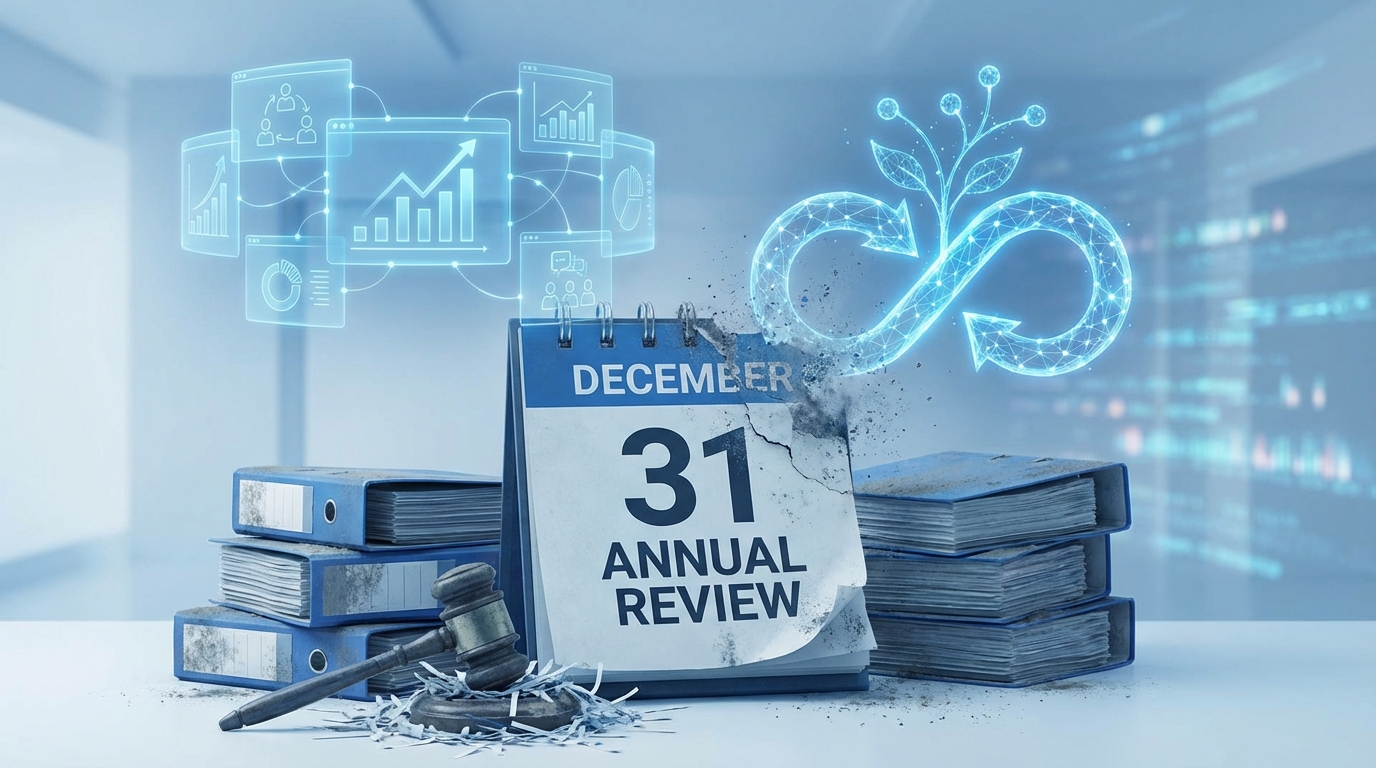
Most annual performance reviews are like trying to steer a car by only touching the wheel once every 12 months. Technically, you can do it, but you will crash into something on the way. You already feel this as a manager or a founder or an employee. You see people wait months for feedback that should have taken 10 minutes. You see tension build around one conversation that tries to replace dozens of small, honest check-ins. That is why annual reviews are dying. Not because feedback is unneeded, but because once-a-year feedback is out of sync with how business and life growth actually work.
Why annual reviews made sense once (and why they do not now)
Annual reviews did not start as evil tools. They solved old problems.
Old work was slower. Careers were more linear. People stayed in companies for many years. Data was on paper. HR processes had to be simple and predictable.
So once a year, companies would:
– Write down what you did.
– Rank you.
– Tie a raise or bonus to it.
It made sense when:
– Roles changed slowly.
– Markets moved in longer cycles.
– Feedback culture was weak or non-existent.
– Managers were trained to “manage” paperwork, not coach people.
Today, that cycle time is broken.
Your strategy shifts every few months. Product features change every few sprints. Your clients expect quick responses. Yet you review performance once a year.
Annual reviews still run on a calendar from the 1980s while your business runs on a calendar from next quarter.
The mismatch is what kills their value.
How annual reviews quietly damage performance
Let us unpack what actually happens around annual reviews inside a team. Not the policy on paper. The real behavior.
1. Feedback arrives when it is too late to act on it
Think about a skill you improved in your life. Sales calls. Writing. Hiring. Public speaking. Fitness.
Did you improve because someone told you once a year what you did wrong?
Of course not.
You improved because you got short feedback loops:
– Try something.
– Get feedback fast.
– Adjust.
– Repeat.
Annual reviews break that loop.
A salesperson hears in December that their discovery questions were weak in April. A marketer hears in January that June’s campaign lacked a clear goal. An engineer hears in November that code reviews have been slow since March.
By the time the feedback lands, the context is gone. The project is over. The emotion is cold. The manager remembers only a vague impression. The employee feels punished for history.
Late feedback feels like judgment; timely feedback feels like coaching.
You can still say “this happened, and we learned from it.” That has some value. But from a performance perspective, delayed feedback is almost like no feedback.
2. People manage impressions, not performance
Once a year, you are scored. That score affects pay, maybe promotion, sometimes job security. This creates a game.
People spend energy on:
– Looking busy when review season is close.
– Gathering “receipts” of good deeds.
– Volunteering for visible work over meaningful work.
– Pleasing the manager who writes the rating.
The metric becomes the target.
The behavior you get:
– Risk avoidance: “If this fails before review season, I am done.”
– Short-term focus: “I just need this to look good on my review.”
– Less honesty: “I will not bring up that mistake now; it might hurt my rating.”
Business growth needs the opposite. You want smart risk. You want long-term moves. You want people to surface problems fast.
Annual reviews push people in the wrong direction.
3. One conversation tries to do five jobs
This is the hidden flaw.
In one annual review discussion, you often try to cover:
– Past performance
– Future goals
– Skill development
– Compensation
– Role changes or promotion
That is too much cognitive and emotional load for one hour.
So the conversation usually collapses around the one thing that feels the most charged: money.
The person is not really listening to growth feedback. They are thinking: “What is my raise percentage? How does it compare with others?”
The manager is not really coaching. They are defending a salary decision decided in a spreadsheet last month.
When pay and ratings dominate the room, real development quietly leaves the room.
This does not mean you should not talk about pay. You should. Just not as a surprise tied to a once-a-year backward-looking report card.
4. Rating systems simplify people into boxes
Many companies attach a numeric score or a phrase to performance:
– 1 to 5
– “Exceeds”, “Meets”, “Below”
– “Top”, “Middle”, “Bottom”
On paper, this feels fair and “objective”. In practice, it has problems.
Managers:
– Remember recent events more than older ones.
– Remember dramatic stories more than steady performance.
– Compare people to each other, not to clear standards.
– Overrate people they personally like.
Employees:
– Fixate on the number, not the narrative.
– Attach their identity to the label.
– Argue about the label instead of the behaviors behind it.
The conversation turns into a debate about a digit.
You are trying to grow a business made of humans. You reduce each human to one line in a calibration meeting. The system becomes more about internal politics than about helping someone actually improve.
5. Annual reviews reward “survivors”, not learners
In an annual cycle, the signal is simple:
“Did you get through the year without big visible failures?”
This fosters a mindset of survival, not learning.
People avoid hard projects that could fail. They cling to what they already know. They say yes to safe tasks. They protect their image.
Growth in business and life needs the opposite. You want people to:
– Try new markets.
– Test new campaigns.
– Experiment with new processes.
– Stretch into uncomfortable skills.
These moves will include missteps. Annual review systems punish missteps. So people play small.
Why business and life growth need shorter feedback loops
You know this from your own experience.
When you get fast feedback, you grow faster. When you wait months, you stall.
The basic growth loop
Growth in any area usually follows a loop like this:
1. Set a clear target.
2. Take action.
3. Get feedback quickly.
4. Adjust.
5. Repeat.
Now map that to performance in a role.
A growth-driven review system lets this loop run many times per quarter, not once per year. That changes everything.
– You course correct earlier.
– You catch misalignment before it hurts the quarter.
– You adjust goals in real time when the market changes.
– You see small wins and build momentum.
This is not fancy theory. This is how top athletes train. This is how high-performing sales teams operate. This is how good founders operate with their teams.
Motivation needs progress, not just pressure
People do not stay motivated only from pressure or fear. They stay motivated when they:
– See progress.
– Feel seen.
– Understand how their work connects to something bigger.
Annual reviews give a big spike of pressure once a year. Progress feels invisible between those spikes.
Regular reviews show smaller, more constant glimpses of progress:
– “Your client retention improved this quarter.”
– “Your code review speed is improving week by week.”
– “Your leadership presence in meetings is stronger.”
Those signals compound.
Clarity beats anxiety
When feedback is rare, people fill the silence with fear.
– “My manager has not said anything. Maybe they hate my work.”
– “I made a mistake last month. It is probably going to come up in the review.”
– “They met with my co-worker. Are they comparing us?”
Regular reviews give clarity:
– “Here is what is going well this month.”
– “Here is one thing to focus on next month.”
– “Here is where you stand against expectations now.”
Clarity does not mean comfort. Sometimes the message is tough. But at least it is current. You are not blindsiding anyone.
What replaces annual reviews: a practical model
Saying “annual reviews are dead” is easy. The real question: what do you run instead so your business does not fall into chaos?
You still need structure. You still need documentation. You still need a way to connect performance to pay and promotions.
Here is a model you can adapt. It works for teams, small companies, and even personal career management.
1. Weekly or bi-weekly check-ins
Short, regular conversations between manager and team member.
They are not formal reviews. They are mini calibration points.
Length: 15 to 30 minutes.
Focus:
– Current priorities.
– Blocks and dependencies.
– Quick feedback on recent work.
– Energy and workload.
Key practice: No long speeches. Ask questions like:
– “What feels stuck right now?”
– “Where do you need my help this week?”
– “What should you stop doing?”
This keeps performance aligned in real time. It also prevents small issues from turning into big review-season shocks.
2. Monthly 1:1s dedicated to growth
Once a month, or at least once a quarter, have a deeper conversation focused on growth.
This is not a status update. You already cover status in weekly syncs.
Topics:
– Skills they want to build.
– Projects that stretch them.
– Behaviors holding them back.
– Feedback you have gathered from others.
Structure can be simple. For example, every month:
– One strength they showed this month.
– One growth area.
– One concrete experiment for next month.
Think of this as coaching, not judging. You are helping them design their next version, not grading their current one.
3. Quarterly performance snapshots
Quarterly, write a short snapshot. Not a novel. Just enough to create a track record.
Typical sections:
– Key outcomes this quarter.
– What went well.
– What needs work.
– Agreed goals for next quarter.
Why quarterly?
– Business goals often run in quarters.
– You remember context better.
– You see patterns sooner.
– Adjustments are more realistic.
You can still store these in your HR system or even a shared doc. The format is less important than the cadence and the honesty.
4. Real-time feedback on specific events
When something notable happens, good or bad, talk about it near the moment.
For example:
– After a client presentation, you debrief for 10 minutes.
– After a failed release, you discuss what happened and what to change.
– After a great campaign, you highlight what worked.
This embeds learning where it happens. It also makes quarterly and yearly summaries much easier. You are collecting insights along the way.
5. Annual conversation focused on the bigger arc
Here is the twist.
You do not remove the annual conversation. You change what it is for.
Instead of one huge judgment day, you have:
– Quarterly performance snapshots that already exist.
– Frequent feedback across the year.
– A year-end conversation focused on the bigger story.
Year-end topics:
– What did you learn about yourself this year?
– Where did you grow most?
– What type of work gave you energy?
– What roles or paths are realistic next steps?
Compensation can still be discussed near this time, because budgets often run yearly. The difference is that the performance case is built from many touchpoints, not one rushed form.
Making performance reviews support both business and life growth
Now we tie this to your two interests: business growth and life growth.
For your business: clearer execution, better talent decisions
When performance review cycles shorten, you get better data for decisions.
You can see:
– Who is improving fast.
– Who is stuck but coachable.
– Who is consistently misaligned with values or results.
This helps you:
– Invest coaching where it matters.
– Move people into roles that fit them.
– Let people go with fewer surprises, because they had feedback along the way.
– Reward contributions in closer to real time.
High performers stay because they feel seen and stretched. Underperformers either improve or see that the role is not for them.
Either way, the business benefits.
For your team members: a clearer growth path
Most people do not want generic praise. They want clarity.
They want to know answers to questions like:
– “What does great look like in my role?”
– “Where am I strong already?”
– “What is the next level for me?”
– “What should I work on this quarter?”
A modern review system gives constant answers. Not perfect, but current and specific.
Business growth is just the sum of all these individual growth paths, aligned in one direction. When people grow, the company moves faster and with less friction.
For you personally: better self-review habits
This is not just about your team. It is about you.
You can treat your own performance like an annual report card and then feel stuck. Or you can run a lighter, continuous review process on yourself.
For example:
– Weekly: ask “What did I move forward this week? What blocked me?”
– Monthly: ask “What skill did I practice this month? What will I focus on next?”
– Quarterly: reflect “What bets paid off this quarter? What did I learn about my own style?”
You stop waiting for others to judge your growth. You start running your own learning loop.
Why people still cling to annual reviews (and what to do about it)
If annual reviews are so weak, why do so many companies still use them?
There are a few reasons.
1. They feel “neat” on paper
Leaders like structure. HR likes clear cycles. Finance likes predictability. A yearly rhythm feels simple.
Everyone knows when “review season” starts and ends. Forms go out. Ratings get entered. Salary letters follow.
It gives a sense of control.
Moving to continuous reviews feels messy. People worry:
– “Will managers spend all day on feedback?”
– “How do we track performance without a big form?”
– “How do we set raises without ratings?”
The answer is not to remove structure. It is to shift structure from one big peak to smaller, regular checkpoints.
2. Habit and fear of change
People grew up with annual reviews. They had them at previous jobs. It feels familiar.
Also, leaders can hide behind them. If a conversation is hard, they can say “Wait for review season.” The form becomes a shield.
Shifting to regular feedback requires:
– Managers who can talk about hard things more frequently.
– Employees who receive feedback without spiraling emotionally.
– A culture that accepts imperfect drafts of feedback, not polished scripts.
That takes effort. So some organizations keep the old system because “that is how we do it here.”
3. Confusion between documentation and frequency
Managers sometimes think:
“If we have more frequent reviews, we will drown in paperwork.”
Not true if you design it well.
You can have:
– Very light weekly notes (or none).
– Short monthly summaries.
– Slightly more formal quarterly snapshots.
– One annual pay review that pulls from previous notes.
You do not need huge documents every time. You just need enough structure to see patterns.
4. Over-reliance on ratings for pay decisions
Many companies tie pay tightly to numeric ratings, often with forced distributions. That system is built to work with annual cycles.
This creates side effects:
– Managers spend more time arguing for “their” people’s numbers than coaching them.
– People game the system.
– Collaboration suffers if people feel they compete for the limited high ratings.
You can decouple this.
You can still have:
– Pay bands by role and level.
– Clear promotion criteria.
– Pay increases that reflect performance tiers.
But you do not need a detailed 1 to 5 scale for every person, every year. You can use broader categories, informed by continuous feedback, not defined only once annually.
Designing performance reviews for humans, not just HR
If you want performance reviews that help both business and life growth, design them around how humans actually behave.
Principle 1: Make feedback frequent and small
Short, honest feedback conversations beat long, rare ones.
Aim for:
– Weekly alignment on work.
– Monthly or quarterly depth on growth.
You do not need perfect phrasing. You need presence and intent.
A simple pattern:
– “Here is what I saw.”
– “Here is the impact I think it had.”
– “Here is what I suggest we try next time.”
Principle 2: Separate development and pay, even if they are linked
Pay will always connect to performance. You cannot fully separate them.
You can separate the conversations in time and tone.
– Use most of the year to talk about skills, behaviors, outcomes.
– Use a smaller window to talk about pay decisions with clear rationale.
This stops every feedback discussion from turning into a negotiation about salary.
Principle 3: Talk about behaviors, not personalities
Annual reviews often drift into vague labels:
– “You are not strategic.”
– “You lack leadership presence.”
– “You are not proactive.”
These are hard to act on. They feel like judgment of who someone is, not what they do.
Instead, anchor to behaviors:
– “In last month’s planning session, you focused mainly on tasks, not why we chose those tasks.”
– “When conflict came up in our last team call, you stayed silent.”
– “When problems appear, you usually wait for me to assign next steps rather than proposing options.”
Then connect this to desired behaviors:
– “Next month, bring one idea for market impact to planning.”
– “In the next conflict, share your view early, even if it feels uncomfortable.”
– “When you see a problem, bring two possible solutions.”
Now the person has something clear to practice before the next review moment.
Principle 4: Build shared ownership of growth
In an annual review model, growth feels like something “given” by the manager. Promotions, ratings, development plans.
In a modern model, you want shared ownership.
The employee owns:
– Their goals.
– Their learning priorities.
– Their self-review.
The manager owns:
– Clear expectations.
– Honest feedback.
– Opportunities and support.
You can prompt shared ownership by asking questions like:
– “What are you trying to get better at this quarter?”
– “Where do you want more feedback?”
– “What is one outcome you want to be known for this year?”
Now the review process is not something that happens to them. It is something they help design.
Principle 5: Keep the system as simple as possible
Complex review systems die in practice. People skip fields. Managers rush them. HR spends time chasing forms.
You do not need a giant competency dictionary with dozens of scores.
You need a few anchors:
– Clear expectations for each role and level.
– A simple structure for regular conversations.
– A central place to record key notes.
If a manager cannot explain the review system in five minutes, it is too complex.
What this means for you right now
If you lead a team or a business, here is a simple path forward without overhauling everything at once.
Step 1: Stop making the annual review the main event
Keep it for now if the organization is not ready to drop it. But reduce the weight.
Tell your team:
“The annual review is just one checkpoint. We will have more frequent conversations across the year so nothing is a surprise.”
Then follow through.
Step 2: Start a lightweight monthly growth conversation
Even if the rest of the company stays with annual reviews, you can run your own upgrade.
Once a month, schedule a 20 to 30 minute 1:1 with each direct report. Agenda:
– What are you proud of this month?
– Where did you struggle?
– One strength you saw in yourself.
– One area we think you can grow.
– One experiment or focus area for next month.
Take brief notes. Over time, these notes become your real performance record.
Step 3: Give one piece of feedback within 48 hours of a key event
Choose one key event this week.
Maybe a big client call, a team meeting they led, a piece of work they shipped.
Within 48 hours, have a short conversation:
– “Here is one thing you did well.”
– “Here is one thing to adjust next time.”
Do this regularly. You will see how much more practical this feels than saving everything for December.
Step 4: Start reviewing yourself on the same cycle
Ask yourself monthly:
– “Where did I help performance grow this month?”
– “Where did I avoid a hard conversation?”
– “What feedback did I give that landed well?”
– “What feedback did I avoid or delay?”
Your own growth in giving reviews is part of the system. If you grow, the whole process improves.
Step 5: Share results, not just opinions
Over a few quarters, you will likely see smoother execution, fewer surprises, and clearer growth paths. When you talk about changing review systems with peers or leaders, share those outcomes.
For example:
– Time to correct a behavior dropped from six months to one month.
– Team engagement survey responses about “I know where I stand” improved.
– Voluntary turnover of top performers decreased.
You do not need to position it as a grand theory. Just show that shorter, more human feedback loops work better for both business and life growth.