| Type of Event | Cringe Level | Builds Real Trust? | Good for Remote / Hybrid? | Best Use Case |
|---|---|---|---|---|
| Escape Rooms | Low | High | Yes (virtual & in-person) | Problem solving, collaboration, leadership |
| Forced Icebreakers | High | Low | Yes | Quick intros, one-off meetings |
| Happy Hour / Drinks | Medium | Medium | Hard for remote | Informal bonding, celebrating wins |
| Workshops & Training | Medium | Medium | Yes | Skill building, new initiatives |
| Volunteer Days | Low | High | Mixed | Values alignment, cross-team bonding |
You probably do not need another “Two Truths and a Lie” in your life. Your team does not either. What you need is a way for people to trust each other, read each other, and work together without feeling like they are stuck in a forced company picnic. That is why picking the right kind of team event matters more than most leaders admit. Done well, it changes how your team talks on Monday morning. Done badly, it follows you as an inside joke for months.
If the event feels fake, your people will protect themselves. If it feels real, they will show up as themselves.
Let us walk through what makes most team building feel awkward, what actually works in a business context, and why escape rooms keep coming up as a surprisingly strong option for real collaboration and growth.
—
Why Most Team Building Feels Cringe
You know the pattern.
Someone sends a calendar invite with a vague title like “Team Bonding Session.” No real agenda. Maybe HR is involved. People start guessing what is coming. Icebreakers. Trust falls. Maybe a personality test everyone will forget next week.
The problem is not that your team hates connection. People want good relationships at work. The problem is the gap between what the business needs and what the event asks them to do.
Three reasons classic team building fails
1. It feels disconnected from real work
Your team spends all week solving problems under pressure. Then the event asks them to toss a ball around in a circle and share “a fun fact.” Their brain goes: this is not how my job works.
2. It forces vulnerability too fast
Sharing “your biggest fear” with someone you barely know is not bonding. It is awkward. Trust is built step by step, not by jumping into deep confessions on a Tuesday afternoon because the slide deck says so.
3. There is no clear win
People like to know what success looks like. Many activities do not have a shared goal. Or if they do, it is fuzzy. So time passes, everyone pretends to engage, then goes back to real work.
When adults feel forced into something that has no clear point, they do not rebel. They disengage.
You see it in the body language: crossed arms, fake laughs, phones under the table. That is your culture telling you, “This is not it.”
—
What Non-Cringe Team Events Have In Common
Events that actually build stronger teams share a few simple traits. They look different on the surface, but the structure is the same.
1. A clear, shared goal
There is something to win or something to lose.
Solve the puzzle. Ship the prototype. Cook the meal. Hit the target.
When the group shares one clear outcome, people naturally start collaborating. They ask questions. They negotiate. They challenge each other. That is what you want to practice.
2. Real constraints
Time limits. Rules. Limited resources.
Constraints force communication and prioritization. They surface how people react under pressure, but in a safe way. No real client is watching. No actual revenue is at risk. Just enough pressure to make the behavior honest.
3. Everyone has a role that matters
In weak events, a few voices dominate while others fade into the background.
Strong events have structure that pulls quieter people in. Puzzles that need different strengths. Visual tasks. Logic tasks. Communication tasks. Physical tasks. That mix lets different people shine.
4. Debrief that connects back to real work
The actual growth often comes after the activity. The reflection. The “What did we learn about how we operate together?”
Without that, you only get entertainment. With it, you get a shared language for future projects.
Fun is good. Fun with reflection is culture change.
—
Why Escape Rooms Keep Coming Up in Business Circles
Escape rooms look like a weekend thing. Friends, dates, birthday parties. Yet if you talk to managers who have used them for teams, you hear the same pattern.
They walked in as co-workers. They walked out understanding each other better.
What actually happens in an escape room
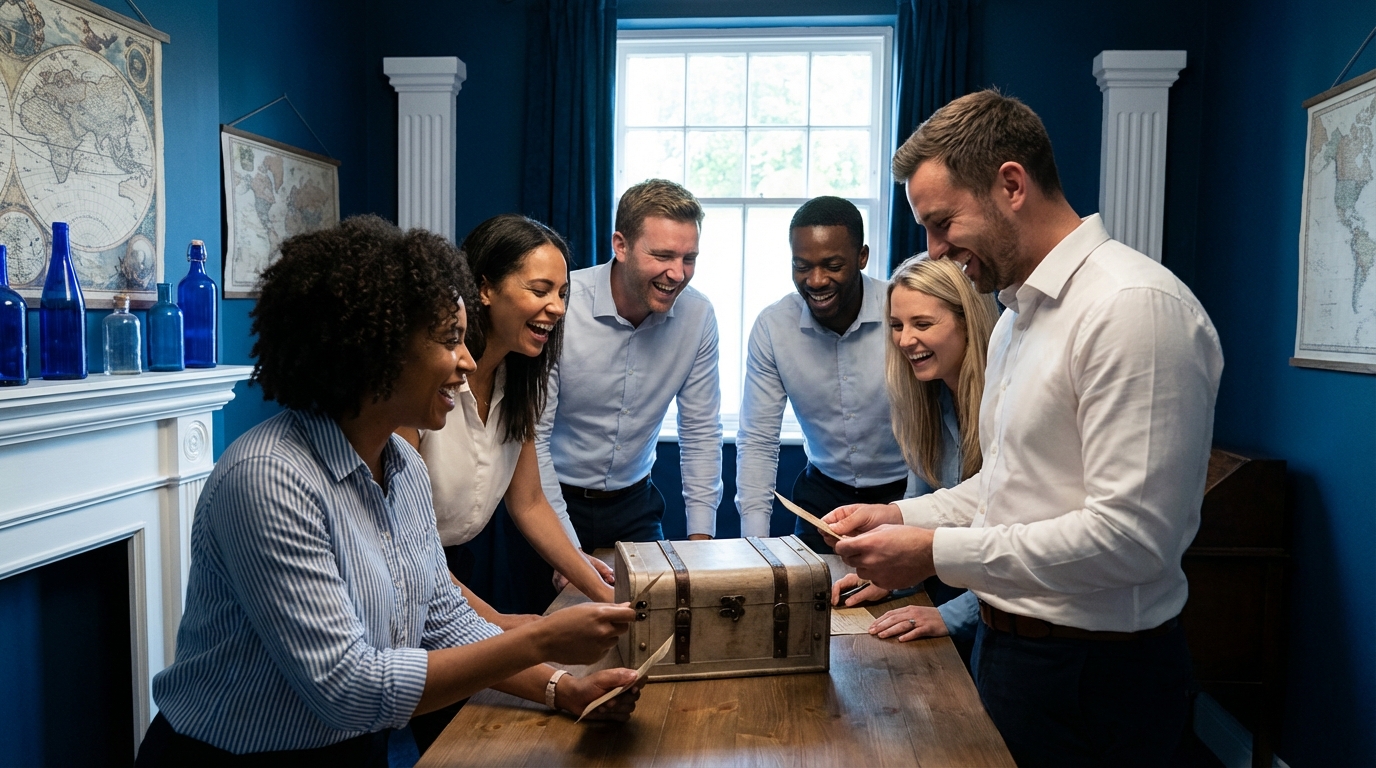
You put 4 to 10 people in a themed room. There is a backstory, a time limit, and a clear outcome: get out. To get there, you solve a chain of puzzles. Codes. Riddles. Patterns. Physical locks. You need to search, test, and share information quickly.
Within 10 minutes, you usually see:
– Who grabs the whiteboard or takes notes
– Who starts scanning the room for hidden details
– Who tries to organize people into roles
– Who keeps quiet but notices key clues
– Who gets frustrated and who stays calm when something does not work
This is the real team dynamic, compressed into an hour.
The stakes are low. Nobody loses a promotion if you fail. Yet people reveal their default habits. That gives you gold to work with later in your regular work.
Why it feels less cringe than most events
1. The focus is on the puzzle, not on your private life
You do not have to share your childhood story. You just need to solve a series of problems. That is safe for introverts, and still engaging for extroverts.
2. The game gives structure
The room itself guides you. There is a clear start, middle, and end. That removes a lot of social guesswork that usually makes people nervous.
3. Everyone can contribute something
You do not have to be the loudest voice to be useful. Maybe you spot a number pattern, or notice a small symbol, or remember a clue from earlier that others forgot.
4. There is a built-in story
Humans remember stories better than meetings. “Remember when we spent 10 minutes stuck on that one lock” sticks in people’s minds. Those shared stories feed future trust.
You are not just “building team spirit.” You are watching how your people actually think, talk, and lead under pressure.
—
Using Escape Rooms as a Business Tool, Not Just Entertainment
If you treat an escape room like a random afternoon out, you still get some benefit. But if you treat it as a designed part of team growth, it becomes much more powerful.
Step 1: Start with a clear purpose
Before you pick a venue or book a virtual room, answer one question:
What do you want to see or improve in your team?
Some common goals:
– New team that has not worked together before
– Department that struggles with communication
– Leadership group that needs better cross-functional trust
– Remote team that never shares the same physical space
Write the goal down. Share it with your leadership group. This will guide which room you pick, how you group people, and what questions you ask in the debrief.
Step 2: Pick the right format (in-person vs virtual)
Escape rooms are not just physical anymore. Many providers offer:
– In-person rooms at a location
– Portable kits they bring to your office
– Online escape rooms run through Zoom or similar tools
For co-located teams, physical rooms are great. For remote or hybrid teams, virtual escape rooms are surprisingly strong. They rely more on communication and less on physical searching.
A virtual format also removes geographic bias. No “fun” only for people who live near HQ.
Step 3: Mix the right people together
This part is strategic.
You can group people in a few ways:
– Cross-functional (marketing, sales, product, ops mixed)
– Hierarchy blend (ICs and managers together)
– New hires with veterans
If you want to break silos, go cross-functional. If you want to see how the leadership bench behaves, put managers together in one room and compare how they work.
One practical tip: avoid putting direct manager-report pairs where people feel like they are being graded. You want honest behavior, not “performing for the boss.”
Step 4: Brief the team the right way
How you frame the event sets the tone.
Keep it simple:
– This is for fun and learning
– Nobody is being tested
– Focus on how you communicate and problem solve together
You are not running an exam. You are giving your people a playground where patterns show up fast.
—
What Escape Rooms Quietly Reveal About Your Team
If you watch with a business lens, you will start to notice patterns that probably exist in your projects too.
1. Leadership style under time pressure
In many rooms, one or two people take charge. That is not always bad. Yet how they lead tells you a lot.
– Do they ask for input or just give orders?
– Do they delegate or hoard tasks?
– Do they stay calm when the clock is ticking or snap at people?
You might see someone in a junior role step up in a way you never noticed at the office. That is a signal for promotions, stretch projects, or mentorship.
2. How information flows
This is huge.
In an escape room, clues are scattered. No one person sees the whole picture. Success depends on sharing small details.
Watch for:
– Do people shout across the room or talk in small groups?
– Do they repeat key information so everyone hears it?
– Does anyone act as a “hub” who pulls information together?
Teams that struggle here usually struggle in real projects with miscommunication, duplicated work, and missed context.
3. Relationship with failure and experiments
A good escape room is trial and error. You rarely get the lock code right the first time.
How does your team respond?
– Do they freeze after a few failed tries?
– Do they switch strategies quickly or keep repeating the same guess?
– Does anyone say “Let me try a weird idea” without fear of judgment?
This is your culture of experimentation on display, in a contained setting.
4. Inclusion of quieter voices
Watch for the person who spots many clues but cannot get attention. Or the one who hangs back even when they have ideas.
Ask yourself:
– Does the group make space for them?
– Do louder people check in: “Anyone see something we are missing?”
– Are ideas dismissed based on who shares them, not on the quality?
If someone gets ignored inside a game, they are likely getting ignored in meetings too.
Now you have a story that is easier to discuss than “You talk too much in standups.” You can say, “Remember the escape room, where we missed that clue because we did not listen to Ana?”
—
How To Run a Strong Debrief Without Making It Awkward
The debrief is where an escape room connects back to business growth. You do not need a full workshop. You just need some clean questions.
Right after the room: capture fresh reactions
Within 15 to 30 minutes of finishing the room:
– Gather the group
– Keep it casual, maybe around a table or in a lounge area
– Ask open questions and let people share in their own words
Some prompts that work well:
– “What surprised you about how we worked together?”
– “Where did we get stuck?”
– “Who took on a role you did not expect?”
– “What did we do well that we rarely do at work?”
Your job is to listen. Not to lecture.
Connect insights to real projects
Once people have shared, gently connect:
– “When did we communicate really well?”
– “Does that remind you of a project where we could have used the same approach?”
– “What did this show you about how we handle deadlines and unknowns?”
Aim for 1 to 3 simple takeaways, not a long list.
Examples:
– “We work better when one person keeps track of clues and next steps.”
– “We need to slow down for 10 seconds before jumping into random guesses.”
– “We got better when people started saying out loud what they tried and what failed.”
These can turn into small changes:
– Designating a “communication lead” in complex projects
– Adding a quick “What do we already know?” check at the start of meetings
– Encouraging people to share failed tests openly
A second touchpoint a week later
To make the learning stick, come back to it once.
In a 15 minute slot during a team meeting:
– Ask: “What from the escape room have you noticed in our work this week?”
– Invite one or two people to share concrete moments
This keeps the story alive, without dragging it out.
—
Designing Non-Cringe Events Around the Same Principles
Escape rooms work well, but the core principles can guide any event you plan.
Principle 1: Make the activity feel like a game, not a test
People relax when there is permission to fail.
So pick activities where:
– Winning is clear, but failure has no long-term cost
– Experimenting is encouraged
– There is no “scorecard” tied to performance reviews
Think: hack days, build challenges, cooking challenges, problem-solving workshops, small internal competitions where people present solutions to a shared problem.
Principle 2: Create shared constraints
If you remove constraints, people split into side conversations.
Examples of constraints:
– 60 minutes to tackle a challenge
– Fixed supplies or budget
– Limited information that needs to be shared
Shared constraints make the group talk more. That is the behavior you want to strengthen.
Principle 3: Protect psychological safety
Non-cringe means people do not feel exposed.
So avoid:
– Activities that push people to share personal trauma
– Events that highlight physical limits in a way that can embarrass someone
– Competitive setups where one person is “the loser” in front of everyone
Instead, highlight team wins and collective effort.
—
Design Tips: Making Escape Room Events Work for Different Team Types
Your team is not a generic group. Their context matters.
For introverted or technical teams
Many dev, data, and product teams lean introverted. Classic icebreakers drain them. Escape rooms are a better fit because:
– They reward careful observation
– Puzzles appeal to logical minds
– The focus is external (the room), not on emotional sharing
To support them:
– Pick rooms with strong puzzle logic, less heavy role play
– Allow a few minutes of quiet scanning at the start before pushing talk-heavy tasks
– Use the debrief to invite written reflections or small group discussion, not just large-group talk
For sales or extrovert-heavy teams
Sales teams often enjoy high energy and competition.
For them:
– Pick rooms with higher intensity, more story, maybe a race format across groups
– Consider running multiple rooms at the same time and compare completion times
– Focus your debrief on listening skills, not just talking and persuasion
These teams might talk a lot but struggle with information discipline. Use the experience to highlight when too much talk gets in the way of clear action.
For remote or distributed teams
Remote teams need shared experiences even more. They lack hallway chat and casual connection.
Virtual escape rooms can:
– Provide a rare moment where everyone is present and focused on the same thing
– Surface how people communicate over video and chat
– Highlight timezone and connection challenges in a low-risk setting
Tips:
– Keep group sizes small (4 to 6 per virtual room)
– Ask people to keep cameras on, if bandwidth allows
– Encourage verbalizing what they see on screen, to mimic in-person pointing
You can record the session (with consent) and later show short clips in a team retro to illustrate patterns.
—
Collaboration Lessons You Can Steal Directly From Escape Rooms
You do not need to wait for your next event to start changing behavior. Many of the habits that win escape rooms apply to projects.
1. Say everything out loud
In a room, winning teams talk constantly:
– “I found a key under the chair.”
– “I tried 1-2-3-4 on that lock; it did not work.”
– “This clue might link to that map on the wall.”
At work, this maps to:
– Sharing early progress
– Broadcasting failed attempts
– Calling out assumptions in real time
The goal is a shared mental map, not silent individual progress.
2. Appoint a coordinator
When nobody owns the overall flow in a room, people repeat the same tries.
Winning teams often have one person who:
– Tracks which clues are solved or unsolved
– Assigns tasks based on strengths
– Pulls people back when they fixate on one puzzle for too long
At work, that is your project lead. The lesson: leadership can be about coordination, not just decision power.
3. Rotate roles
In escape rooms, success increases when people switch roles:
– Searcher becomes solver
– Solver becomes communicator
– Silent observer steps up as connector
At work, this rotation:
– Builds empathy
– Reduces burnout
– Reveals hidden strengths
You might learn that your “quiet engineer” is great at leading small subgroups, or that your “big talker” is better in a single-owner research role for parts of a project.
4. Notice when pressure turns into chaos
Escape rooms have a clock in your face. People feel the countdown.
Teams that crumble:
– Talk over each other
– Rush without checking their logic
– Stop listening when stress rises
Teams that hold together:
– Pause briefly to reset strategy
– Listen more, not less
– Have someone call timeouts: “Everyone pause for 30 seconds.”
At work, deadlines do the same thing. You can borrow that “timeout” habit directly. A 5 minute reset can save weeks of messy rework.
—
How To Sell Non-Cringe Team Events to Skeptical Leaders
You might be convinced, but your boss or finance person wants a business reason. That is fair.
Escape rooms and similar events are not just “fun days.” They are a practical way to protect and grow performance.
Here are a few angles that tend to land:
Reduced friction in cross-team projects
People who have solved puzzles together find it easier to:
– Ask for help
– Challenge assumptions kindly
– Give each other the benefit of the doubt
That reduces micro-delays and miscommunication over months.
Earlier detection of leadership potential
In an escape room, hidden leaders show fast. You see:
– Who organizes chaos
– Who keeps people calm
– Who mediates conflict
That can save you from promoting the loudest person rather than the right person.
Stronger engagement and retention
People stay longer in teams where they feel:
– Known
– Trusted
– Safe to speak
Events like this are not the whole story, but they are part of it. They send a signal: “We invest in how we work together, not just what we produce.”
—
Practical Mistakes To Avoid When Planning an Escape Room Event
Even with good intent, a few missteps can turn a promising event into another eye-roll.
1. Making it mandatory fun with no choice
If people feel forced, they resist. When you announce the plan:
– Explain the purpose
– Offer at least some input (date, time, or format)
– Make space for people with genuine constraints
You do not have to give an opt-out for everyone, but you can be flexible around family, disability, or faith needs.
2. Picking a theme that clashes with your culture
Some rooms are horror themed. Others are heavy on violence or criminal plots. In a mixed workplace, that can be uncomfortable.
Safer themes:
– Mystery
– Heist without graphic content
– Adventure
– Science lab
– Historical puzzle
A quick check with HR or your people team avoids surprises.
3. Forgetting accessibility
Think about:
– People who cannot stand for long periods
– Claustrophobia
– Sensory sensitivities (loud noises, flashing lights)
Many providers have options with more space, seats, or less intense elements. Ask directly.
For virtual rooms, think about audio captions, color blindness, and clear instructions.
4. Skipping the debrief entirely
If you play, laugh, then go home, the event still has value. People bond. They get a shared memory.
Yet you lose the chance to connect that experience to daily work. Even a 15 minute reflection right after is worth the calendar time. That is where growth happens.
—
Linking Team Building, Escape Rooms, and Long-Term Growth
Business and life growth both come back to how you handle problems with other humans.
Your company faces puzzles every quarter:
– New markets
– Changing customer behavior
– Internal constraints
– Tight deadlines
Your personal life faces its own puzzles:
– How you manage time
– How you communicate in relationships
– How you deal with stress and uncertainty
Escape rooms are not magic. They will not fix broken culture on their own. Yet they are one of the cleanest micro-labs for the skills you need in both domains.
You learn:
– How you behave under time pressure
– How your team responds when things do not go to plan
– Where you step up, and where you hide
– What kind of conversations help you get unstuck
If you can treat an escape room as practice for real collaboration, it becomes more than a company outing. It becomes a mirror.
A mirror for your leadership.
A mirror for your team.
And, if you pay attention, a mirror for how you show up in business and life, far beyond that locked door and ticking clock.