| Area | Paper Office | Paperless Office |
|---|---|---|
| Search | Manual, slow, depends on people | Instant search by name, tag, content |
| Security | Locked rooms and cabinets | Permissions, encryption, audit trails |
| Cost | Ongoing paper, ink, storage | Upfront software + smaller ongoing fees |
| Access | Office-only, business hours | Anywhere, multiple devices |
| Compliance & Audits | Box hunting, missing files | Logs, version history, central archive |
The reason this table matters is simple: if your documents are slow, your business is slow. A document management system is not about looking modern. It decides how fast you close deals, fix problems, train people, and protect yourself when things go wrong. Go paperless the right way and work feels lighter. Do it wrong and you just move your chaos from cabinets to the cloud.
Why paper is quietly taxing your business
Most companies still run on hidden paper habits. You might have cloud tools, but invoices get printed, contracts get signed on paper, HR forms live in binders, and someone in finance still has a drawer that no one else touches.
This drains time in ways you rarely measure.
You pay for paper, toner, storage, and cabinets. You also pay with something bigger: delay. Documents sit on desks. They wait in mail. Someone is on leave, so a file is stuck in their drawer. You chase signatures. You hunt for that “final_final2” version.
You probably feel it in moments like this:
– You need an old contract, but the person who managed it left.
– An auditor asks for evidence, and your team spends days scanning and sorting.
– A client disputes something, and you know you have proof, but you cannot find it in time.
Technically, paper can still work. Some teams run tight systems with color folders, labels, and clear rules. But once you grow, once you go remote or hybrid, or once compliance gets stricter, the cracks start to show.
What “paperless office” really means
People throw around “paperless” as if it means scanning everything.
It is not just scanning.
A true paperless office has five pieces working together:
1. Documents are born digital when possible.
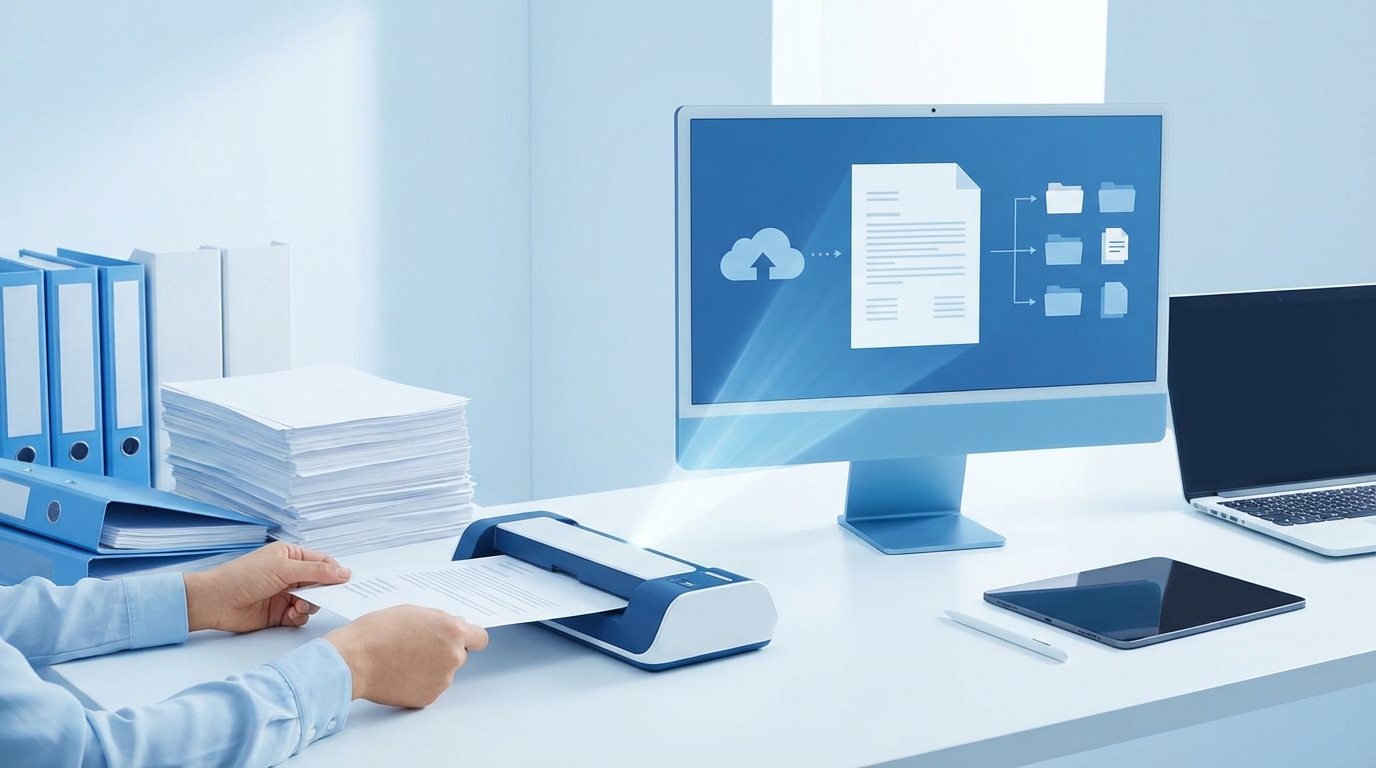
2. Incoming paper is scanned quickly and consistently.
3. Files live in one main system, not scattered across tools.
4. Access is controlled, logged, and easy to manage.
5. Workflows around those documents are mapped and automated.
You might still use some paper for a while. That is fine. The point is that paper is not the default anymore.
What a document management system actually does
A document management system, or DMS, is more than a fancy folder.
At a basic level, a strong DMS will:
– Store files in a central place
– Control who can see and change what
– Track versions and changes
– Index content so you can search inside files
– Keep records for legal and compliance needs
– Connect to tools you already use
Good systems treat documents like living objects, not dead files. They have a lifecycle: created, reviewed, approved, shared, revised, archived.
A DMS that works is one you barely notice in daily work. It fades into your normal habits instead of fighting them.
The core building blocks
Let us break down what you actually need from a DMS so you do not get lost in feature lists.
1. Capture: getting documents into the system
This is the doorway. If capture is messy or slow, people will bypass it and your system will fail.
You want:
– Direct save from apps: Word, Google Docs, email, scanners.
– Email capture: save from inbox or auto-forward certain addresses (like invoices@yourcompany.com).
– Mobile capture: scan with a phone camera that straight away uploads to the right spot.
– Bulk scanning: for legacy files and mailrooms.
Your capture step should ask: what is this and where does it go? That is where metadata comes in.
2. Metadata: how you describe documents
Folders alone are not enough. They break once your volume grows.
Metadata is info about the file, like:
– Client name
– Project code
– Document type (contract, invoice, policy, etc.)
– Status (draft, under review, approved)
– Owner or department
– Date ranges
With good metadata you can filter, search, and report. You can say “show me all signed contracts renewed in the last 12 months” without guessing folder paths.
You do not need 20 fields. Start with 4 to 7 that matter for your business. You can expand later.
3. Storage and structure
You have two main patterns:
– Folder-based: Looks like traditional folders, familiar, but can get messy.
– Metadata-driven: Less focus on folder paths, more on search, filters, and views.
Most modern DMS tools mix both.
Your structure should reflect how you work, not your org chart. People move teams, teams rename, but clients and projects stick.
For example:
– Top level by client
– Inside by engagement or product line
– Inside that by document type
You do not need it perfect from day one. You just need “good enough” and consistent.
4. Access control and security
Security in a DMS is not just about stopping hackers. It is also about internal control.
You want to control:
– Who can see which folders or document types
– Who can edit, approve, or delete
– Who can share outside the company
The baseline:
– Single sign-on if you can (Google Workspace, Microsoft 365, Okta).
– Role-based groups: HR, finance, managers, etc.
– Clear rules for sensitive data (HR files, payroll, contracts, legal matters).
And you want logs: who viewed, who edited, who downloaded. That is your safety net during disputes or audits.
5. Version control
Without version control, you will always have confusion.
A DMS that works keeps one “canonical” version with a full history. You never save “v7_final3”. You just check out, edit, and check in. Or you co-edit live.
You should be able to:
– See what changed and when
– Restore older versions
– Lock a document to stop edits after final approval
If your team still emails attachments back and forth internally, your version control is broken.
6. Search and retrieval
If finding a file takes longer than 10 seconds, people start building their own side systems. Shared drives. Local folders. Email hoarding.
Your DMS should allow:
– Search by file name and content
– Filters by metadata
– Saved searches for common needs
– Suggested results as you type
Good search is what makes a paperless office practical. Without it, everything feels heavier than paper.
7. Workflow and automation
Once your documents live in a DMS, the next level is workflow.
Common flows:
– Contract: draft → legal review → client review → signature → archive.
– Invoice: received → matched with PO → approved → paid → stored.
– HR: candidate documents → hiring approval → onboarding → employee file.
You can route documents, set due dates, and create approval steps.
The trick is to keep it simple. Start with the flows that cause the most delay or risk. You can add complexity later, but do not start there.
8. Retention and compliance
Different document types have different lifespans.
You might keep:
– Tax and financial records for a set number of years
– HR records for a specific period after someone leaves
– Client work for another set time
A DMS can:
– Tag documents with retention policies
– Lock files from deletion during legal holds
– Auto-archive or flag records when they reach end-of-life
This reduces risk and clears clutter without manual effort.
Common types of document management systems
Not all tools marketed as DMS are equal. They fall into rough groups.
1. Cloud storage tools with DMS features
Think:
– Google Workspace (Drive, Shared Drives)
– Microsoft 365 (SharePoint, OneDrive)
– Dropbox Business
– Box
These started as simple file storage, then added:
– Sharing
– Version history
– Permissions
– Search (often pretty good)
– Basic workflows and approvals
For many small and mid-size teams, these are enough, if configured well.
Strengths:
– Familiar interfaces
– Easy to roll out
– Strong integrations with email and office tools
– Reasonable pricing
Limits:
– Complex compliance rules can be hard to maintain
– Deep workflows sometimes need add-ons or custom work
If you already pay for Google Workspace or Microsoft 365, you may already have what you need. The real work is in structure, rules, and training.
2. Dedicated DMS platforms
These focus on deeper document control.
Some examples:
– M-Files
– DocuWare
– eFileCabinet
– Zoho WorkDrive (with Zoho Docs)
– Laserfiche
They often bring:
– Strong metadata-first approach
– Built-in workflows
– Detailed audit trails
– Compliance options for regulated fields
– Better scanning and capture tools
These fit organizations that handle:
– High document volume
– Strict regulation (legal, healthcare, finance, public sector)
– Complex, multi-step approvals
Trade-offs:
– More setup work
– More training
– Higher cost
– You may need help from consultants
3. Industry-specific platforms
Some tools focus on one field:
– Legal practice management with built-in DMS
– Construction project systems with plans and RFIs
– Medical record systems
– Real estate transaction suites
These can be great when your field has very specific requirements.
Downside: you might get locked into one vendor, and cross-department use can be limited. Finance or HR might not fit well into a legal-only tool, for example.
4. Hybrid and on-premise systems
Some companies keep documents on their own servers.
Reasons:
– Strict data residency requirements
– Legacy systems
– Very large scale
This can work, but it usually demands IT capacity: patching, backups, redundancy, security.
Most growth-focused businesses now prefer cloud or at least hybrid models. You offload heavy lifting to the vendor and focus on process and people.
How to pick a DMS that actually works for you
Tools fail when they ignore context.
Your choice should grow out of three questions:
1. How big is your team and how fast is it growing?
2. How sensitive is your data?
3. How structured are your processes today?
Question 1: Team size and growth
If you are under 20 people, with light regulation, you often can:
– Use Google Workspace or Microsoft 365 properly structured
– Add an e-signature tool (like DocuSign, Adobe Sign, or others)
– Use a scanning app connected to Drive or SharePoint
Your main work at this stage is culture and structure.
If you are 20 to 200, with mixed remote staff, you need:
– Clear folder and metadata design
– Defined access groups
– At least basic workflows for contracts, invoices, and HR
If you are over 200, spread across locations, or have tight compliance, you should consider:
– A dedicated DMS with stronger workflow and auditing
– Or a well-planned SharePoint or similar build-out
Question 2: Data sensitivity and compliance
Consider:
– Do you store health, legal, or financial data?
– Do you work under regulations like HIPAA, GDPR, SOC 2, PCI, or sector rules?
– Do clients demand proof of document security and retention?
If yes, you want:
– Strong access control
– Detailed audit logs
– Encryption at rest and in transit
– Clear retention management
– Vendor certifications
When vendors pitch you, ask less about features and more about real scenarios. For example:
“Walk me through how your system would handle a legal hold on all documents related to Client X between these dates.”
Their answer tells you how mature the system is.
Question 3: Process maturity
If your current process is “we save stuff where it feels right,” adding a heavy DMS will not fix that. It will just make you frustrated faster.
Start simple:
– Agree on a common naming pattern.
– Agree where each type of file lives.
– Agree who owns each area.
Then layer tools on top of that.
If you already have written processes, RACI charts, or clear approval paths, you can use more advanced DMS features with less friction.
A practical path to a paperless office
Let us walk through a realistic step-by-step path. Not theory. Something that you can actually run over a few months.
Step 1: Pick 2 or 3 critical document flows
Do not try to fix everything. Start where the pain and risk are highest.
Common candidates:
– Sales contracts
– Vendor invoices and bills
– HR onboarding and employee records
– Client project files
Pick up to three. Measure how long they take today and where they get stuck.
Step 2: Map how these documents move now
Sit with the people who actually move the documents.
Ask them:
– Where does this document come from?
– Where does it go next?
– Who has to touch it?
– Where does it get stuck?
Draw it. Boxes and arrows. Nothing fancy.
You will see gaps like:
– No clear owner at some stage
– Hand-offs missing
– Version chaos
– Overlapping tools
Step 3: Define “future state” for those flows
Now design a simpler path for each one:
Example: Sales contracts
Current:
– Sales rep drafts in Word locally
– Sends via email to manager
– Manager edits and forwards to legal
– Legal sends back with tracked changes
– Rep merges feedback
– Rep sends PDF to client
– Client prints, signs, scans, emails back
– Rep saves to desktop then moves to some shared folder
Future:
– Rep starts from approved template in DMS
– Draft saved straight into client folder
– Manager and legal review in the system
– Final version sent through e-signature
– Signed contract auto-saved in client folder with metadata
Write this out step by step. Agree as a group. This will guide your config later.
Step 4: Choose or confirm your main platform
By now, your choice is easier.
If you already have:
– Microsoft 365 and use Teams, Outlook, and Office daily
Then your best path is likely:
– SharePoint + OneDrive as your DMS layer
– Power Automate for workflows
– Teams channels for collaboration
If you are deep into Google tools:
– Shared Drives as your DMS
– Google Drive labels or naming rules for metadata
– add workflow and signature tools on top
If your needs are more strict, compare 2 or 3 dedicated DMS vendors against the flows you mapped.
Do trials. Not test accounts that sit idle. Let a small group run real work through them for 2 to 4 weeks.
Step 5: Design structure and metadata
With flows and platform in mind, define:
– Top-level structure (clients, projects, departments, or a mix)
– Standard folder names
– A minimal metadata set
For example, across your system you might use:
– Client name
– Document type
– Status
– Owner
– Confidentiality level
Do not let every team invent its own language at first. Keep a shared glossary.
If people are arguing over three different names for the same thing, fix the vocabulary before you fix the software.
Step 6: Set access rules
This is where many projects stall because people overcomplicate security.
Start with broad roles:
– All staff
– Managers
– HR
– Finance
– Sales
– Projects
Then add sensitivity layers:
– Public internal docs
– Company confidential
– Strictly confidential (HR, legal, payroll, some contracts)
Give each role default access levels by document area. Avoid one-off exceptions at the start. You can always add them later.
Remember: security that nobody understands turns into people bypassing systems.
Step 7: Plan scanning and legacy docs
You have past paper. What do you do with it?
Break it into:
– Active files: current clients, open projects, live vendors.
– Archive: old matters, closed projects.
– Compliance: records you must keep for legal reasons.
Prioritize active files for scanning and migration.
Set rules:
– What gets scanned fully
– What gets scanned on demand
– What you keep in paper form
Give someone clear responsibility for scanning. A DMS without discipline at the front door will slowly rot.
Step 8: Pilot with a small group
Pick a team that:
– Handles one of the critical flows you mapped
– Has at least one person who likes testing new tools
– Feels the pain you are trying to solve
Run your new DMS process just for them, for 30 to 60 days.
During this time, watch:
– How long tasks take compared to before
– Where they get stuck
– Where they ignore rules
Talk to them weekly. Adjust. Fix small friction points quickly.
Step 9: Train with real tasks, not slides
When you roll out more widely:
– Do short live sessions
– Use real documents from your business
– Walk through specific flows end-to-end
For example:
“Let us all upload a new contract, tag it, send it for approval, sign it, and store it.”
Record these sessions. Build a small internal “how we handle documents” guide with short videos and screenshots.
Most failures are not due to bad tools. They come from vague training and mixed messages.
Step 10: Create simple ground rules
Write a one-page document policy. Not a long manual that nobody reads.
Include:
– Where documents live
– How to name them
– How to share internally and externally
– Which tools to avoid for sensitive files
– Who to ask when unsure
Make it part of onboarding. Make managers model it. Culture follows leadership here.
How this changes your daily work
Let us anchor this with a few real scenarios.
Scenario 1: New hire onboarding
Old way:
– HR emails a pack of forms
– New hire prints, signs, scans or brings them in
– HR prints copies for files
– Access to tools is requested through a messy chain of emails
New paperless way:
– HR triggers an onboarding workflow in the DMS
– New hire receives a secure link with all docs
– They fill and sign digitally
– Forms and IDs are stored in their digital employee file
– Access requests are auto-routed and logged
Time drops from days to hours. HR gets consistency. The new hire gets a smoother first week.
Scenario 2: Client dispute
A client challenges an invoice or delivery.
With a DMS:
– You search by client name and date range
– You pull related contracts, emails, change orders, and meeting notes
– You see who approved what and when
Instead of scrambling, you respond with calm facts. This shifts the tone of the whole conversation.
Scenario 3: Remote work and travel
Someone travels, or you hire remote staff.
With a proper DMS:
– They access documents from anywhere
– They collaborate in real time
– They do not need VPN access to random shared drives you forgot about
This gives you flexibility in hiring and in crisis situations.
Costs you should plan for
A working paperless setup has more costs than just licenses.
You will invest in:
– Time to map processes
– Training and coaching your team
– Some scanning effort
– Maybe external help for design and setup
But you gain back:
– Faster response times
– Fewer lost documents
– Less repeat work
– Stronger compliance posture
The trap is under-investing at the start. Buying the tool is the cheap part. Aligning your habits around it is where payback happens.
How to know your DMS is actually working
You do not need a complex dashboard to gauge success. Watch a few key signs.
Sign 1: Search complaints drop
Before, people say:
– “I cannot find anything.”
– “Where did you save that?”
– “Who has the latest version?”
After rollout, you want to hear that less. If those complaints stay the same, examine:
– Structure and naming
– Metadata usage
– Training gaps
Sign 2: Fewer side systems
People naturally build their own systems when central ones do not work.
If your DMS is working, you see:
– Less use of personal cloud storage for work
– Fewer email attachments for internal drafts
– Less “local copy” hoarding
If shadow systems grow, you have a trust problem with the DMS.
Sign 3: Faster cycle times
Measure time from:
– Contract draft to signature
– Invoice received to approval
– New hire offer to fully onboarded
You want steady reduction over the first 3 to 6 months. Even small drops here have large effects across a year.
Sign 4: Cleaner audits
Ask your finance, legal, or HR leads after your next audit or review:
– Was it easier to gather documents?
– Did you have to chase fewer people?
– Were there fewer “we do not have that” moments?
If they smile more than last time, your DMS is pulling its weight.
When you should not go fully paperless yet
There are cases where going all-in right away is not wise.
For example:
– Your processes are informal and undocumented.
– Your culture fights any shared system.
– Leadership is split on direction.
In these conditions, a big DMS rollout is risky.
You can start smaller:
– Standardize naming and folders on your existing cloud storage.
– Introduce e-signature for one process.
– Pilot scanning for one department.
Once those habits settle, you can expand.
The mindset shift behind a paperless office
At the surface, going paperless is about tools. Underneath, it is about how you think about information.
Instead of:
“My files”
You move to:
“Our records”
Instead of:
“I save where I like”
You move to:
“We have one shared way of handling this”
That shift can feel uncomfortable. You give up some personal freedom in exchange for clarity and speed for the whole company.
A DMS that works is not a tech project. It is a behavior project with software attached.
If you lead a team or a company, your behavior sets the tone. If you keep saving contracts to your desktop or sending attachments, your team will ignore the DMS, no matter how much you spend on it.
Practical starter template for your DMS
You can copy and adapt this simple starter structure, then evolve it.
Top level:
– /Clients
– /Internal
– /Vendors
– /HR
– /Finance
– /Legal
Under /Clients:
– /ClientName
– /01_Contracts
– /02_Proposals
– /03_Project_Docs
– /04_Reporting
– /99_Archive
Under /Internal:
– /Policies
– /Templates
– /Brand
– /Training
Basic naming pattern:
– YYYYMMDD_ClientName_DocType_Description
Example:
– 20251224_AcmeCo_Contract_MasterServices
– 20251102_Company_Policy_RemoteWork
Base metadata:
– Client: text or list
– DocumentType: Contract / Invoice / Proposal / Policy / Report / Other
– Owner: person
– Status: Draft / In review / Approved / Signed / Archived
– Confidentiality: PublicInternal / Confidential / Restricted
You can implement this in Google Shared Drives or SharePoint on day one, then add automation later.
When you review this in six months, you will see what needs to be changed. That is normal. Systems that work grow with your business, they do not freeze it.
Final thought on “systems that work”
A document management system that works is not the one with the most functions. It is the one your team uses without thinking about it too much.
If you keep asking three questions as you build:
– Is this simpler than what we had before?
– Can a new hire understand this in one week?
– Does this reduce risk in a visible way?
You will avoid many traps.
Your office may never be fully “paperless” in some strict sense. That is fine. The goal is not zero paper. The goal is zero confusion about where your information lives and how it flows through your business.